
Sizing Guide
What Size Dumpster Do I Need in Elizabethtown, KY?
Two Hardin County customers need two different boxes, and the city line is part of the reason. How to size on material rather than on how big the pile looks.
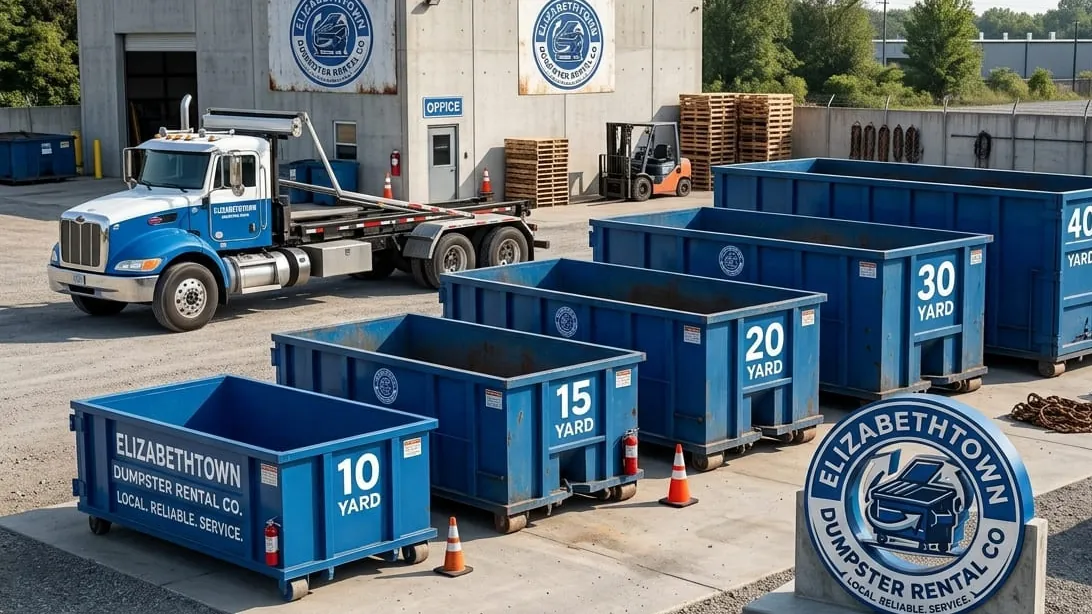
The honest answer to “what size dumpster do I need” in Elizabethtown starts with a question back: what are you actually throwing away, and where does the truck have to put the box? Those two answers settle it almost every time. Everything else — the cubic-yard number, the length of the rental, the shape of the driveway — falls out of them.
This guide is written for Hardin County specifically, because sizing here is not the same problem it is in a denser market. Two things make it local. The first is that fewer than half the occupied homes inside the Elizabethtown city limits are owner-occupied — 49.3 percent, against 62.6 percent across Hardin County as a whole (US Census QuickFacts). The second is rain: this county gets roughly fifty inches a year, spread across every month, and water is weight. Both of those change what box you should be standing in front of.
Two Hardin County customers, and they do not need the same container
That owner-occupancy gap is not a statistic for its own sake. It describes two genuinely different jobs.
Inside the city limits, the work skews toward turnover: a rental being reset between tenants, a landlord clearing a unit, an apartment cleanout, a move-out against a hard date, an estate that has to be emptied so a house can be listed. That work is bulky and light. Furniture, mattresses, carpet, boxes, particle-board shelving, the contents of a garage. It fills volume fast and weighs comparatively little.
Out in unincorporated Hardin County — Rineyville, Cecilia, Stephensburg, White Mills, Glendale — the work skews the other way: owner-occupied renovation, an outbuilding coming down, a barn floor, a tear-off, brush and stumps from clearing a corner of a lot. That work is dense and heavy. It reaches the lawful weight a truck can carry long before it reaches the top rail of the box.
Volume and weight are two different sizing problems. Getting them mixed up is the single most common sizing mistake in this market.
The five sizes, and what each one is actually for
We run five: 10, 15, 20, 30 and 40 yards. The full comparison lives on the sizes page; this is the plain-language version.
The 10-yard
The short, low box. It is the one you want when the material is heavy and the pile is small: a concrete patio, a section of sidewalk, a brick chimney, a bathroom gut, a small tile floor, dirt from a footing. It is also the one that fits where nothing else will — a tight city driveway on the older streets, a shared drive, a spot between a house and a fence line. If you are working with concrete or other heavy debris, this is almost always the right box even when the pile looks small enough to be embarrassing.
The 15-yard
The in-between size, and it is underrated. A single-room remodel with mixed material — drywall, cabinets, a countertop, some flooring, packaging — usually lands here. So does a serious garage or basement clearout in a house that has not been over-accumulated. If a 10 feels like it will be tight and a 20 feels like you are paying for air, the 15 exists for exactly that judgment call.
The 20-yard
This is the default for a whole-house declutter, and it is the size we place most often in Elizabethtown. Furniture, carpet, closets, a full garage, an attic, the shed, the contents of a basement. It is big enough that you are not rationing space and low enough that most people can still get bulky items over the side without a ramp. For an estate cleanout or a residential clearout, start here and adjust after we have talked about what is actually in the house.
The 30-yard
The renovation box. A whole-floor gut, a kitchen and two bathrooms at once, a house being stripped back for a flip, siding and windows, a large deck coming down. It is also the right answer for a demolition of a small outbuilding where the material is bulky rather than dense — framing, sheathing, roofing over sheathing, siding. Thirty yards of air-filled construction debris is a normal load. Thirty yards of anything dense is not.
The 40-yard
Commercial and large-site work: a store fit-out, an office strip-out, a big construction job producing continuous light debris, a large-volume cleanout on an acreage. Two things to know about it before you ask for one. It needs room — both the footprint and the space behind it for the truck to set it down and pick it up. And it is a volume box, not a weight box. Filling a 40 with anything dense is not a plan.
The second axis: weight, not volume
Every container that leaves a driveway in Hardin County is limited by what the truck may lawfully carry on the road, not by how much will physically fit inside the walls. That limit is the same whichever box you choose. So the practical rule is:
- Light and bulky — furniture, carpet, insulation, cabinetry, packaging, household clearout — size up. Volume is your constraint.
- Dense and compact — concrete, brick, block, tile, mortar, dirt, sod, asphalt, plaster, wet material of any kind — size down. Weight is your constraint, and you will hit it with the box half empty.
People find that counter-intuitive, because the instinct is to take the biggest box for the biggest job. With heavy material the biggest box is the wrong answer: you either cannot fill it or you fill it and it cannot lawfully go anywhere. Tell us what the material is before you tell us how big the pile looks, and we will size on the material.
Roofing never goes in a 30 or a 40
This one is absolute in this market. A tear-off reaches lawful payload long before it fills the box. Shingles are dense, and a Hardin County roof with two or three layers on it — common on the 1970s stock, which is the single biggest decade in the county’s housing at 16.2 percent of it — is heavier than anyone expects.
For a roof tear-off, the conversation is about squares and layers, not about yards. Count the squares, count the layers, and call. Putting a residential tear-off in a 30 is the classic way to end up with a container that is a third full and cannot be moved. There is a fuller treatment in our roof tear-off sizing guide.
In this county, rain is a sizing factor
There is no dry season in Hardin County. The long-run picture for Elizabethtown is roughly fifty inches of precipitation a year and about five inches of snow, distributed across all twelve months, with May the wettest month at about 5.8 inches and September the driest at about 3.1 inches. Those are 1991–2020 normals as published by a climate data service rather than a figure we pulled from NOAA ourselves, so treat them as round numbers — but the shape is right and it matters.
Two consequences for sizing:
- An open container left through a wet week gains weight. Drywall, carpet, plaster, insulation, cardboard, soil and yard debris all soak up water and hold it. A load that would have been fine dry can be over the line after three days of rain. If the material is absorbent, keep it covered, or plan on a smaller box and a faster turn.
- May is peak renovation season and it is also the wettest month. September is the driest month and still mild — if you have any choice at all about when to schedule an outdoor demolition or a tear-off in this county, September is the best month on the calendar for it.
Do not size for what the City will already take
Inside the Elizabethtown city limits, the City runs three collection programs, and if part of your pile qualifies for one of them, you do not need to buy container space for it.
Brush collection takes “debris resulting from trees and shrubs which have been pruned or trimmed at residential and small commercial properties,” provided it is “less than twelve (12) inches in diameter and/or five (5) feet in length,” on a four-week rotating schedule across four service areas. Leaf pick-up runs in the fall, with bagged leaves in clear bags that do not exceed 50 pounds, and the City asks you to “separate brush and debris from loose leaves piles.”
But read the limits, because they are where a project lands. Brush collection “does not include collection of cut trees and shrubs or debris resulting from the clearing of land,” and the City states plainly that “licensed contractors must remove and dispose of debris from their own work professionally.” And the City’s annual Spring Clean-Up — published for 2026 as “March 30th thru May 1st — junk and debris” — refuses, in writing, “no garbage, hazardous materials, liquids (paints, oil, antifreeze, etc.), construction debris, tires, or automobiles.”
So the City will take your washing machine and your hedge trimmings, and it will not take your drywall. Size the container for the part the City refuses. There is a full breakdown in the City clean-up, brush and leaf guide. Program dates move — confirm current dates with Public Works on (270) 737-7890.
What the city code says about letting it pile up instead
There is a reason not to under-size and then stage the overflow in the yard for a few weeks. Elizabethtown’s code is unusually explicit that accumulation is itself the offense. § 92.031(F) makes it a violation to fail to dispose of all garbage, debris and rubbish “at least one time per week.” § 92.031(B) requires anything “that can be blown away by the wind” to be in a covered container. And § 92.030 provides that “violation of this subchapter shall be deemed a public nuisance.” The code is published by American Legal Publishing and you can read it yourself at the Elizabethtown code library.
One more from the same section, and it is genuinely useful sizing advice: § 92.031(A) gives you 96 consecutive hours for anything “subject to decay,” except in a tightly covered container. So do not put kitchen waste, food or anything that rots into a roll-off that is going to sit for a week. Bag that and put it out with your regular collection. The container is for the debris.
Outside the city limits, the job is usually bigger
Rural Hardin County jobs run larger for a simple reason: there is more room to have accumulated things, and more structures to take down. An outbuilding, a pole barn, a mobile home pad, a fence line, thirty years of a workshop. If you are in unincorporated county, or in Radcliff, Vine Grove, Sonora, Upton or West Point, tell us on the call which of those it is — because the jurisdiction changes the permit answer even when it does not change the box. That fork is explained in which side of the city line are you on.
One Kentucky specific worth knowing when you are sizing a land-clearing job: the Commonwealth’s own definition of construction/demolition debris, at 401 KAR 47:005, is “waste resulting from the construction, remodeling, repair, and demolition of structures and roads, and for the disposal of uncontaminated solid waste consisting of vegetation resulting from land clearing and grubbing, utility line maintenance, and seasonal and storm related cleanup.” Note that Kentucky puts land-clearing vegetation and storm cleanup inside the same definition as demolition waste. That is not true everywhere, and it affects how a mixed rural load is handled.
Getting it wrong, in both directions
Too small costs you a second haul and a gap in the middle of the job where the debris has nowhere to go and the crew is standing around. On a job with a hard finish date — a listing, a closing, a report date — that gap is the expensive part, not the container.
Too big costs you less than people fear on a light load, and quite a lot on a heavy one, because a large box invites people to keep adding dense material until the load cannot lawfully move. The 40 is not a bigger 20; it is a different tool.
The cheapest correction is a two-minute phone call before delivery, not a swap on day three.
The short version
- Heavy material — concrete, brick, tile, dirt, roofing: 10 or 15, and talk to us first.
- Whole-house declutter or estate: 20 is the default here.
- Renovation, gut, siding, decking: 30.
- Commercial, fit-out, continuous light debris: 40, if there is room for it.
- Roof tear-off: never a 30 or a 40. Count squares and layers, then call.
- Absorbent material in a wet week: cover it, or go a size down.
Tell us the material, the address and roughly when you want it, and we will tell you the size. Call (270) 900-6891 and ask for Wes. If you would rather read further first, the cost guide explains what actually moves a price in this market, and what can and cannot go in a container in Kentucky covers the material questions that change the size answer.
Questions this guide did not answer? Call (270) 900-6891. We would rather spend two minutes on the phone than have you order the wrong container.