
The bulk box
30 Yard Dumpster Rental in Elizabethtown, KY
Tall walls and real volume, for a house being emptied completely, a lot being cleared, or a commercial fit-out with genuine bulk in it. One rule travels with it everywhere: no roofing, ever.
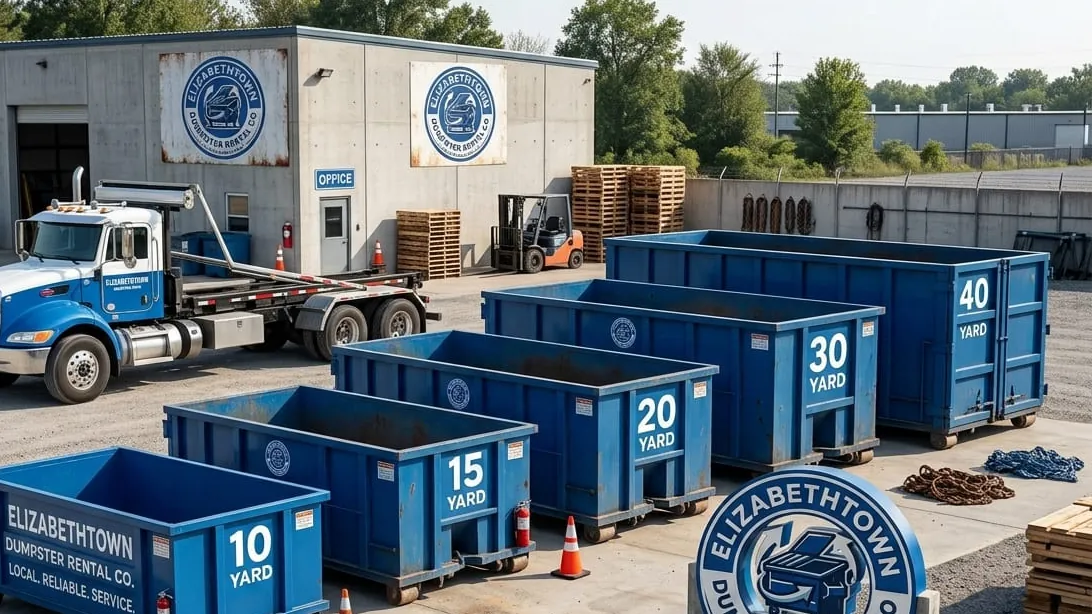
A 30 yard roll-off is about twenty-two feet long, eight feet wide and roughly six feet tall — nine to twelve pickup loads. It is the same footprint as a 20 with taller walls, which is exactly what makes it useful: it takes more volume without needing more ground. The trade is that you are loading over a higher wall, so it suits material that is carried or thrown rather than shovelled.
- Capacity30 cubic yards
- Box size22 x 8 x 6 feet
- Weight allowance4 to 5 tons
- Roughly equal toaround 9 to 12 pickup loads
Why the 30 gets picked around here
The 30 is the right box when a property is being emptied completely rather than tidied. Estate work is the clearest case — a house somebody lived in for decades, with a garage and a shed and forty years of decisions in them — and it is common here, because county owner-occupancy runs 62.6 percent against 49.3 percent inside the Elizabethtown city limits, which puts the long-tenure houses disproportionately outside the city. On a job with a deadline attached to it, the extra volume buys something specific: the option not to sort. That is worth more than it sounds when a family has four days and a closing date.
The second case is land clearing and large storm work, and Kentucky’s own regulations put those squarely in this category. 401 KAR 47:005 defines construction and demolition debris to include “uncontaminated solid waste consisting of vegetation resulting from land clearing and grubbing, utility line maintenance, and seasonal and storm related cleanup.” A felled tree with its crown, a cleared fence line, or a yard full of ice-broken limbs is bulky, springy and full of air, and it wants height. Cut to length as you load, because uncut brush fills a 30 with very little actual wood in it. The City’s brush program will not help — it takes pruning and trimming only, under twelve inches in diameter and five feet in length, and expressly excludes debris from the “clearing of land.”
The third case is commercial. A tenant fit-out, a retail reset, an office clear-out or a warehouse tidy produces ceiling grid, shelving, partitions, furniture and a great deal of flattened packaging — light material with real volume, which is precisely what a tall box is for. On a commercial property, note that the container is inside the scope of the Commonwealth’s fire code in a way it is not at a house: Kentucky’s Standards of Safety, 815 KAR 10:060, adopt NFPA 1 (2018), whose combustible waste and refuse provisions are in Chapter 19, and Section 2(1) of that regulation applies it to all buildings except one and two family dwellings. Placement questions on a commercial building go to Elizabethtown Fire Prevention, (270) 765-2121.
And here is where the 30 is wrong, stated plainly because it is the single most expensive sizing error in this trade. Roofing never goes in a 30. Torn asphalt shingle is dense and does not compress; a 30 loaded with shingle reaches a lawful road payload when it is roughly a third full, at which point the container cannot legally leave the property and the remedies are unloading by hand or splitting the load. The same is true of anything mineral — concrete, block, brick, tile in mortar, soil, sod, rock — all of which belong in a 10 yard loaded flat. A 30 is for volume with no weight in it. Ask it to carry weight and it stops being a container and becomes a problem.
The fourth case is weather work, and this county has a specific record rather than a general one. Winter here is an ice problem rather than a snow-depth problem — December through February lows average in the low to middle twenties — and the benchmark event is the January 2009 ice storm, verified for this part of Kentucky as a regional event rather than as a Hardin County statistic, which is how we will leave it. Ice loads limbs until they fail, and what comes down is bulky, springy, soaked and tangled with whatever it landed on. Wind is the other half. The 3 April 1974 Super Outbreak put an F5 through Meade County that killed 31 people, 28 of them in Brandenburg; the National Weather Service has a confirmed EF-1 at Rineyville on 31 October 2018; and in December 2021 Grayson County took an EF4 and Hart County an EF2 — both places we serve, and neither of them a claim about Hardin County, where the sources conflict and we say nothing. For a container, storm debris behaves like land clearing: cut to length as you load, keep the stump and its root ball out because they arrive with soil and stone attached, and get a cover over it before the next front, since saturated wood and water-damaged contents weigh several times what the same volume weighs dry. Our storm and ice debris guide goes through the sequence.
Good fit for
- A house being emptied completely, outbuildings included
- An estate cleanout on a deadline
- Land clearing, fence lines and felled trees
- A large storm or ice debris clean-up
- A commercial tenant fit-out or retail reset
- An office clear-out with furniture and filing
- A whole-structure demolition, masonry excepted
- A warehouse or pole barn clear-out
Not the right size for
- A roof tear-off of any size, single layer or double
- Concrete, block, brick, tile in mortar, soil or sod
- Trench spoil, rock and driveway gravel
- Wet, water-damaged material in any quantity
- A narrow rural drive with no room to swing the truck
- A short driveway where the tailgate cannot open clear
Will it fit?
The 30 has the same footprint as a 20 but stands about six feet tall, so the constraint moves from the ground to the air and to the tailgate. The truck wants a straight run to back in, working width either side, and genuine overhead clearance for the hoist — the box goes up higher than most people picture when it comes off and goes back on, so a service drop, a carport roof, a low branch or a mature shade tree over the drop point will stop it. On older Hardin County properties that is the usual reason a delivery fails, and it is entirely avoidable with a photograph at booking. Behind the box you need room for the tailgate to swing fully open; on a short driveway that is what decides between a 30 and a 20 more often than the volume does. Surface as always: plywood under the wheels and rear rollers, concrete or compacted base rather than turf, and no soft ground after a wet week, which in a county with rain in every month describes a good many weeks. Loading a taller box has its own discipline — keep the heaviest material on the floor and spread rather than piling at the tailgate, and keep everything below the rail, because a heaped container cannot lawfully be hauled. On brush and clearing work, cut to length as you load rather than piling first; a 30 filled with uncut limbs holds a surprisingly small tree. And keep the light material covered: inside the city limits § 92.031(B) makes it a violation to let anything “that can be blown away by the wind” accumulate other than in a covered container, and a tall box catches more wind than a low one.
Start with the address, and give us the one the county knows rather than the one the mail uses, because on our own road the difference is real: North Dixie Highway carries Elizabethtown addresses, then Radcliff addresses above roughly the 4900 block, and between the two there is a stretch that sits in no incorporated place at all. One road, one ZIP code, three governments, three different answers. Then clear the drop point of vehicles, trailers and roll carts, and where the property runs its own septic and well, mark the tank lid, the drain field and the well head, because a driver cannot see any of the three from the street. Last, say what is under the spot and what is over it — a slab poured inside the last month, ground that was filled rather than cut, a shallow water line run beside the drive, a low service drop, or a mature shade tree standing over the only flat piece of the yard. A loaded box puts several tons through four small contact patches, which is why it is concrete or a compacted base rather than turf, with plywood under every wheel and both rear rollers as standard. Weight decides the box as well as the surface, and the one rule that never bends here is roofing: a tear-off never rides in a 30 or a 40, because shingle reaches lawful payload long before it fills a container that size. Ground is the other thing about this county worth saying out loud rather than burying. The Kentucky Geological Survey names Elizabethtown among the karst cities of the Western Pennyroyal, and there are four things we will not do with that. We will not tell you a heavy truck causes a sinkhole, because no agency says it and KGS attributes collapse to water and soil piping. We will not read a map and pronounce a property safe or at risk, because KGS says its own sinkhole data is “not recommended for predicting future subsidence.” We will not publish a percentage or a count for Hardin County, because there is not an honest one to publish. And we are not geologists — nobody has surveyed your driveway, and anyone answering that question off a website is guessing. Water is the practical half of it: there is no dry season in this county, roughly fifty inches of rain spread across every month of the year, May the wettest and September the driest, and a winter risk that is ice rather than snow depth. An open container standing through a wet week collects water, water is weight, and weight is what disposal is billed on — so keep it covered.
Two rules sit above the placement itself, and Kentucky writes both of them differently from the states either side of it. The first is fire, and it is the one most often got wrong in print: the Commonwealth does not use the model fire code most of the country adopts. Its Standards of Safety at 815 KAR 10:060 adopt NFPA 1 (2018), and combustible waste and refuse is its Chapter 19 — the parent chapter, which is as far as we are prepared to take it in print. We could not verify a subsection or an operative clearance figure from a source worth citing, so we publish neither. What we will publish is the exemption, because it settles most of what we set: § 2(1) of that regulation applies it to all buildings “except one (1) and two (2) family dwellings.” A container on a driveway at a house sits outside its reach altogether. Standing tight against a store, a restaurant, a school, a warehouse or a larger apartment building it does not, and at that point the only question worth asking is who actually looks at it: Elizabethtown Fire Prevention, (270) 765-2121.
The second is whose ground the box is standing on. On private property — a driveway, a yard, a parking lot — is where close to everything we set goes, and no city permit surfaced in anything we read for a container standing entirely on private ground; that is an honest “we could not find one,” not a “there is none.” The moment any part of the box has to stand in a city street or on a sidewalk we stop guessing on your behalf: ring the City on (270) 765-6121 and Public Works on (270) 737-7890 before the truck rolls, and do not assume the driveway rules travel into the street. Chapter 72 of the city code carries sections on obstruction of parking and on limitations on stopping and parking, plus § 72.11 on long vehicles and § 72.13 on cul-de-sacs. We know those by title, we could not retrieve the operative text, and we are not going to tell you what they require. Past the city limits the answers change again, and we will not pretend otherwise: in Radcliff, Vine Grove or any other city, ask that city, because nothing behind this site establishes another town’s container or right-of-way rules; on unincorporated ground the desk is the Hardin County Planning and Development Commission, (270) 769-5479. And where the frontage is a numbered route rather than a plain named street — our own address on North Dixie Highway is US 31W, a state primary route, and so are US 62, US 31E, I-65 and the parkways — the right-of-way belongs to the Kentucky Transportation Cabinet rather than to City Hall. That is KYTC District 4, 310 Valley Creek Road here in Elizabethtown, (270) 766-5146, whose encroachment application is form TC 99-1 under 603 KAR 5:120. Last, where your own project breaks ground — a footing, a stump, fence posts, a sewer lateral — Kentucky 811 comes before the shovel: dial 811, allow two full working days and not more than ten under KRS 367.4901 to 367.4917, the ticket stays good for 21 calendar days, and inside the 18-inch tolerance zone either side of the mark you hand-dig. We do not publish a toll-free number for the call center, because we could not verify one, and we do not tell you Kentucky flatly requires white-lining, because the statute makes it conditional — mark the dig area anyway where you can, since it makes the locate better. Setting a container down is not excavation; digging to make room for one is. Our driveway protection guide and the Elizabethtown placement and permit guide take all of that further than a size page usefully can.
The five side by side, weight before volume
| Size | Box size | Weight allowance | Roughly equal to | Suits |
|---|---|---|---|---|
| 10 Yard Dumpster | 12 x 8 x 3.5 feet | 2 to 3 tons | around 3 pickup loads | Broken driveway, block and footing spoil. Limestone is dense: this one is full by weight long before it looks it. |
| 15 Yard Dumpster | 16 x 8 x 4 feet | 2 to 3 tons | around 4 to 5 pickup loads | A single-layer tear-off, or one room of a 1970s Hardin County house stripped to the studs. |
| 20 Yard Dumpster | 22 x 8 x 4.5 feet | 3 to 4 tons | around 6 to 8 pickup loads | What leaves the North Dixie yard most weeks — an attic, a garage and a basement in one go. |
| 30 Yard Dumpster | 22 x 8 x 6 feet | 4 to 5 tons | around 9 to 12 pickup loads | A whole-floor remodel, forty years of one family’s storage, or a June turnover. No shingle, ever. |
| 40 Yard Dumpster | 22 x 8 x 8 feet | 5 to 6 tons | around 12 to 16 pickup loads | Light, bulky material only, and it needs the longest straight approach of anything on this list. |
Not settled on a size? Tell us the material, roughly how much of it there is, and the street address rather than the mailing town — in Hardin County the address is half the answer, because it decides which of four desks governs the job and what the ground under the box is likely to be. You will have a size and one flat figure before the call ends. Ring (270) 900-6891.
Put a 30 yard on the board
One flat figure, with the drop-off, the collection, your days on site and the disposal already inside it — quoted off the street address, because in Hardin County that is what settles whose rules apply. Same day where the board still has room on it.
(270) 900-6891The other four
Often booked with it
All sizes
What each of the five is for in Hardin County
10 Yard Dumpster
Broken driveway, block and footing spoil. Limestone is dense: this one is full by weight long before it looks it.
View this size → 15yd³15 Yard Dumpster
A single-layer tear-off, or one room of a 1970s Hardin County house stripped to the studs.
View this size → 20yd³20 Yard Dumpster
What leaves the North Dixie yard most weeks — an attic, a garage and a basement in one go.
View this size → 30yd³30 Yard Dumpster
A whole-floor remodel, forty years of one family’s storage, or a June turnover. No shingle, ever.
View this size → 40yd³40 Yard Dumpster
Light, bulky material only, and it needs the longest straight approach of anything on this list.
View this size →30 Yard Dumpster — the questions we get on the phone
Why can I not put a roof in a 30?
Because you would never fill it and you would break the truck’s payload trying. Torn asphalt shingle is one of the densest things that comes off a house: it does not compress, and a 30 yard container loaded with it reaches a lawful road payload when it is roughly a third full. At that point the box cannot lawfully leave your driveway, and the remedies are unloading by hand or splitting the load — both of which cost a morning that nobody budgeted. The correct answer for a large roof is a 20, and for anything bigger than that, a 20 plus a second pull booked before the crew starts. It is the same tonnage, moved legally, arranged in advance instead of discovered at noon. Tell us your squares and layers on (270) 900-6891 and we will plan the pulls with you.
Is a 30 too big for a residential driveway?
Usually not for the length — it has the same footprint as a 20 — but often for two other reasons. The first is the tailgate: it needs room to swing fully open behind the box, and on a short driveway that is what rules it out. The second is overhead. A 30 stands about six feet tall and the hoist lifts it higher still, so a service drop across the drive, a carport roof or a mature limb over the only flat spot will stop the delivery. Both of those are solvable with a photograph before the truck leaves the yard, and both are the usual reason a delivery gets turned around here. If the drive is narrow or the overhead is tight, two swaps of a 20 gives you the same volume with an easier placement. Ring (270) 900-6891 and describe the approach.
Can I put a whole tree in it?
You can put a great deal of tree in it, provided you cut as you load rather than piling first. Uncut limbs fill a container with air: a crown loaded whole can take most of a 30 while representing very little actual wood. Cut to length, stack rather than throw, and keep everything below the rail because a heaped container cannot lawfully be hauled. Keep the stump and root ball out — those arrive with soil and stone attached and belong in a 10 yard loaded flat. Worth knowing why this is a container job at all: the City’s brush program takes only pruning and trimming under twelve inches in diameter and five feet in length, and it expressly “does not include collection of cut trees and shrubs or debris resulting from the clearing of land.” See our yard waste page.
Does the fire code affect where a 30 sits at my business?
On a commercial property, yes, and it is worth getting the Kentucky version right because most of the internet gets it wrong. Kentucky does not use the model fire code most of the country adopts. The Commonwealth’s fire code is the Kentucky Standards of Safety, 815 KAR 10:060, which adopts NFPA 1, Uniform Fire Code, 2018 edition; its combustible waste and refuse provisions sit in Chapter 19. Section 2(1) of the regulation applies it to “all buildings except one (1) and two (2) family dwellings” — so a store, restaurant, school, warehouse or apartment building is inside its scope, and so is a triplex or a fourplex, because the exemption stops at two. A single-family house or a duplex is not. We will not publish a clearance in feet for Kentucky, because we could not verify the operative figure from a source we trust. Elizabethtown Fire Prevention, (270) 765-2121, are the people who will actually look at it.
Is this the size for a demolition?
For the bulky half of it, yes. A whole-structure demolition — a detached garage, a barn, an outbuilding, an interior strip-out — produces framing, roofing material, siding, drywall and fixings, which is bulk, and it produces block, brick, footings and slab, which is weight. The 30 takes the first; the second goes in a 10 yard loaded flat. Planning for two containers from the start is cheaper than discovering the need for the second one halfway through. Two things to settle before the first swing, both covered on our demolition page: inside the city limits a demolition permit is required under § 154.011, at $50 residential and $100 commercial as published in § 150.16 — confirm current fees on (270) 765-6121 — and the asbestos question is answered by testing rather than by assumption.
Can I not just burn it instead?
On the county’s rural fringe that is a live option, and the rules out there are not ours to state — ask the Hardin County Planning and Development Commission on (270) 769-5479, and for anything beyond ordinary yard waste the Kentucky Division for Air Quality. Inside the Elizabethtown city limits, § 92.031(I) is a good deal narrower than most people assume. Burning garbage is a nuisance anywhere in the city, at any time. Burning debris or rubbish is a nuisance as well, “except in an approved incinerator.” What is left is wood, tree branches and yard trimmings, and even that carries conditions: Fire Chief approval, a permit where one is required, fifty feet from any structure, an adult supervising it throughout, and an extinguishing agent to hand. The Fire Chief may ban burning outright. So for a house being emptied, an outbuilding coming down or a fence line cleared, the fire is not the shortcut it looks like, and § 92.030 deems a violation of that subchapter a public nuisance in terms. Elizabethtown Fire is (270) 765-2121. That is a City ordinance and nothing more — it is not a state rule, and it does not describe what any other city in this county does.
Services
What goes into a 30 yard around here
Residential Dumpster Rental
Two in five Hardin County houses predate 1980, and their attics and garages show it.
Learn more →Commercial Dumpster Rental
Businesses inside the limits, where Fire Prevention on (270) 765-2121 will look at the box.
Learn more →Construction Dumpster Rental
Mixed build waste in one box, swapped next day, from the city line out to the county roads.
Learn more →Roofing Dumpster Rental
Squares and layers, never roof area — and never a 30 or a 40, whatever the roofer asks for.
Learn more →Roll-Off Dumpster Rental
Five box sizes, out of the North Dixie Highway yard every working day of the week.
Learn more →Same-Day Dumpster Rental
Call before nine and the afternoon board usually still has a slot on it.
Learn more →Talk to a real person
Need a 30 yard in Elizabethtown?
Give us the street address rather than the mailing town, say what is going in, and you will have the size, one flat figure and a day before you hang up. Nothing on this site to fill in, and nothing waiting in an inbox overnight.
Elizabethtown, the rest of Hardin County, and seventeen more places across seven counties · Mon–Fri 6:30am–5pm, Sat 7am–1pm