
How-To
Driveway Protection on Kentucky Limestone
Elizabethtown is one of the karst cities the Kentucky Geological Survey names. Here is what that does and does not mean for where a container sits, and the four claims we will not make.
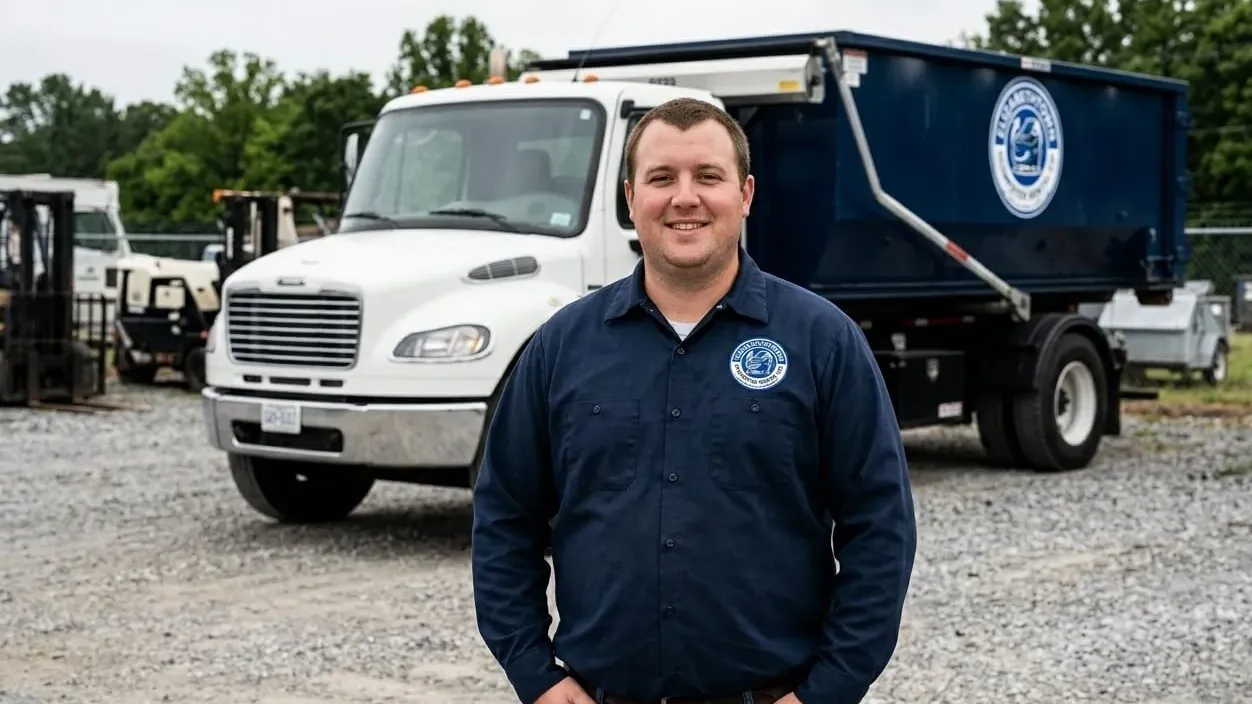
Most driveways in this county were poured to hold a car, a pickup and a basketball hoop. For a week or two during a project, one of them is asked to hold a steel box with several tons of building in it, plus the vehicle that delivers and collects it. That is the whole subject of this page.
It is a slightly longer subject here than in most markets, because of the second thing every Hardin County driveway has in common: limestone underneath it. The Kentucky Geological Survey names Elizabethtown, Fort Knox and Munfordville among the karst cities of the Commonwealth’s Western Pennyroyal region — three of the seven on that list are in this service area — and KGS reports that 25 percent of Kentucky is known to have well-developed karst features.
So: a practical guide to surfaces, plywood, slope, overheads and approach, with an honest account of what the ground here does and does not change about any of it. The geology itself gets its own page; this one is about where the box goes.
Four things we are not going to tell you
Before anything useful, the boundaries. This subject attracts nonsense, and we would rather be the page that refuses to write it.
1. Nothing on this page says a truck makes a sinkhole. No Kentucky agency says it either. We went looking for published guidance from KGS, from the Energy and Environment Cabinet, from anyone, saying that heavy vehicles or concentrated loads trigger karst collapse, and there is none we could find. What KGS attributes collapse to is water moving through rock and soil over time — a fracture in limestone widened by dissolution, and soil gradually carried away underground into the void that results. That is a water story on a geological clock, not a weight story on a Tuesday. What follows is about placement care and ordinary due diligence, and nothing else.
2. We are not going to send you to a map to find out whether your property is at risk. KGS publishes sinkhole data, and the constraint on its own older statewide layer is printed right in the metadata: “Not recommended for predicting future subsidence,” and “these data do not indicate the probability of future cover-collapse or bedrock collapse in the designated areas.” Nobody — not us, not a competitor, not a realtor — should be reading a dot on a map as a verdict about a particular lot.
3. There is no Hardin County karst figure on this page. No percentage of the county, no sinkhole count. KGS publishes statewide numbers and names Elizabethtown among the karst cities; a county-level figure is not something we were able to find published anywhere, and we are not going to borrow one from a study of a different watershed and put a Hardin County label on it. We could not find one — which is not the same thing as saying there is none.
4. We are not geologists. We place containers. If you have an actual concern about your ground, KGS’s own advice is to “always consult a professional geologist who is experienced in identifying karst subsidence and an engineer experienced in sinkhole remediation.” That is their sentence, not ours, and it is the right one.
What we can do is hand you KGS’s homeowner checklist and then be careful about where we set thirty feet of steel.
The checklist KGS gives Kentucky property owners
This is worth reading before you pick a spot for a container — and frankly worth reading anyway if you have bought a house here recently. Quoted from the Kentucky Geological Survey:
- “Ask the seller if any sinkholes have been filled, and, if so, where, how, and by whom.”
- “Look for previous damage to foundations and check doorframes and windows for squareness.”
- “Check the surrounding lot for shallow depressions and arch-shaped cracks in the soil.”
And the sentence that gives the checklist its point, from KGS’s Hardin County pages: “Factories and homes built over filled sinkholes may be damaged as the fill is transported out of the sinkhole and the soil cover collapses.”
The practical translation for a container rental is short. Do not put a loaded box on the soft spot in the yard that has been there since you moved in. Do not put it on the shallow dish in the lawn that the mower always bounces through. Not because a container will cause anything — but because if there is already a question about a patch of ground, that is not the patch to park a loaded container on for a week.
One piece of third-party context is worth having, because it tells you the subject is taken seriously at a level well above a hauling company. The Lincoln Trail Area Development District — the eight-county region Hardin County belongs to — is the subject of a dedicated karst mitigation planning effort, funded by a $293,984 grant from the Federal Emergency Management Agency routed through the Kentucky Department of Military Affairs, with KGS using aerial elevation survey to characterize sinkholes and build a reporting system for collapses. We are citing the grant and what it was for. Whether the resulting plan has been published, and what it says, we could not establish, so there are no findings quoted here. KGS is at uky.edu/KGS; the regional planning body is LTADD.
One methodological point that is fair to make in general terms: Kentucky’s older statewide sinkhole layer was digitized from 7.5-minute topographic maps whose contour intervals run from forty feet down to ten. KGS’s newer layer is derived from five-foot-resolution elevation models built from modern aerial survey, with field checking that KGS reports as better than 85 percent accurate. A five-foot model sees features a forty-foot contour interval never could. The honest general conclusion is simply that the older maps were never the last word.
Now the ordinary part: protecting a driveway
Most of what goes wrong on a driveway has nothing to do with geology and everything to do with a heavy steel box on a surface that was poured for a sedan.
Plywood, and what it actually does
We put plywood down. Three-quarter-inch sheets under the wheels, and boards under the rails where the box sits. Here is what that does and does not achieve, because the difference matters:
- It spreads a point load. The four small contact patches under a loaded container are the thing that marks a surface, and plywood turns four points into four squares.
- It keeps steel off the finish. Rails drag when a box is set and again when it is pulled. That drag is what scars a sealed asphalt drive.
- It does not make soft ground firm. Plywood over saturated soil is plywood on saturated soil. It will not stop a truck sinking in, and it will not stop rutting.
- It does not repair an existing crack. If a drive already has a settled slab or a wide control joint, tell us before delivery so we can set the box off it.
Surface by surface
- Concrete. Generally the most forgiving surface here. Watch old control joints, hairline cracking and any slab that already rocks under a car. Set the box on the strongest run, not across a joint.
- Asphalt in summer. This is the classic. Average highs here run into the mid-eighties in July and August, and hot asphalt is soft asphalt. A loaded box that sits for a week on an August driveway will leave impressions. If the job can go in a cooler month, it should — and if it cannot, more plywood, and set it where the drive is shaded if that is an option.
- Gravel and chip-seal drives, which are ordinary out in the county. They handle weight well and rut easily when wet. Firmest, flattest, best-drained section, and expect to rake afterward.
- Grass and yard. Last resort, and never after rain. Hardin County gets around fifty inches of rain a year with no dry season — May is the wettest month and it is also peak renovation season, which is an unhelpful pairing. If a container must go on turf, it goes on a full plywood run and it goes when the ground is as dry as it is going to get.
The things under a driveway that are not limestone
Out in unincorporated Hardin County especially, there are several ways to put a container in exactly the wrong place:
- The septic tank and the lateral field. If you are on septic, know where it is before the truck arrives. This is the single most expensive placement mistake available on a rural property.
- A cistern lid or an old well cap. Both exist on older Hardin County places, sometimes under a thin skim of gravel.
- A propane tank and its line.
- Culverts and headwalls at the end of a farm drive, which are usually the weakest structure a truck has to cross.
- Sidewalk crossings and apron edges in town, which are thinner than the drive behind them.
Overhead, approach and slope
- Overhead is the number one cause of a failed delivery. The truck raises the box to set it and again to load it. The service drop from the pole to the house and a mature street tree over the drive are the two things that stop us. Walk out and look up before you book.
- The approach needs to be straight enough to back into. In a market with a lot of 1990s and 2000s subdivisions, cul-de-sacs are a real consideration. Elizabethtown’s parking code includes a section on cul-de-sacs and one on long vehicles on the Public Square; we have those by title only and could not retrieve the text, which is exactly why the advice is to call the City on (270) 765-6121 and Public Works on (270) 737-7890 before placing anything in a street.
- Slope. A loaded container on a slope wants to move. Flat is better than convenient. If your drive has real fall to it, say so when you book and we will plan the set.
Call 811, even though a container does not dig
A roll-off does not excavate. But three things on a container job do interact with what is underground: a heavy truck crossing a shallow service, staking or blocking a container, and above all the actual work the container is there for — the fence posts, the footings, the deck piers, the drainage.
Kentucky 811 is free and it is required by law before you excavate. The essentials, from Kentucky’s damage-prevention statutes:
- Dial 811, or file online at kentucky811.org. We do not publish a toll-free alternative, because the one that circulates online we could not confirm from Kentucky 811 or from federal sources.
- Not less than two full working days before you start, and not more than ten.
- The ticket is good for 21 calendar days from the initial request.
- The tolerance zone is 18 inches either side of a mark. Inside it, hand-dig or use non-intrusive methods.
On white-lining — marking out the area you intend to dig — sources genuinely disagree about whether Kentucky requires it universally, and the statute text reads as conditional: on operator request, or where the excavation location cannot otherwise be accurately identified. So we will not state it as an unqualified rule. Plenty of Kentucky locators will ask for it. Do it anyway; it makes the locate better.
What goes in the box, because of what is under it
Karst changes the stakes on one specific thing, and it is worth saying plainly. In most of the country, a spill soaks into soil and moves slowly. Here it does not. The Energy and Environment Cabinet: karst terrain is characterized by “the rapid movement of water through underground channels and conduits,” which “renders karst terranes sensitive to groundwater pollution.” KGS: pollutants entering a karst aquifer are “not filtered.”
So: no liquids in a container. No paint, no oil, no antifreeze, no solvent, no fuel. That is not fussiness and it is not our house rule — the City of Elizabethtown’s own spring clean-up refuses “hazardous materials, liquids (paints, oil, antifreeze, etc.),” and Hardin County’s answer for that material is an annual household hazardous waste event, run by the county, free. The county’s seven round-the-clock drop-offs take only rinsed #1 and #2 plastics, rinsed aluminum and tin, non-greasy cardboard and newspaper: “Items not listed above are not accepted at any drop-off location.” Hardin County Solid Waste is (270) 360-9207.
And the corollary that matters most on acreage: do not bury renovation debris on your own land. Consider how closely the Commonwealth watches a facility that was actually built for the job. Hardin County’s own permitted contained landfill on Audubon Trace, operated by the Fiscal Court, has been in formal groundwater assessment for chloride, sodium, specific conductance and total dissolved solids — with no maximum contaminant level exceedances found, which is the monitoring regime doing exactly what it exists to do. If an engineered, permitted, monitored site gets that level of scrutiny here, a hole in a back field is not a disposal plan. Inside the city limits, § 92.031(E) settles it anyway: dumping on any premises is a violation “with or without the consent of the owner.”
Three numbers we will not give you
People ask us for these and we do not have defensible answers, so here they are as open questions rather than invented ones:
- Frost depth. We could not retrieve a Kentucky-specific minimum footing depth from a source we could actually read; the residential code chapter that would settle it sits behind a subscription. If you need a frost depth for a footing, get it from Elizabethtown Planning and Development, (270) 765-6121, or from HCPDC, (270) 769-5479, in writing.
- Soil series. No soil survey for Hardin County was available to us this session, and we are not going to name a soil type we have not read.
- Bearing capacity. Same answer, and it is an engineer’s number in any case, not a hauler’s.
The short version
- Plywood under the wheels, boards under the rails, every time. It spreads the load; it does not firm up soft ground.
- Firmest, flattest, best-drained surface you have. Not the soft dish in the lawn.
- Not on turf after rain. Fifty inches a year and no dry season.
- Know where the septic, the cistern and the propane line are before the truck arrives.
- Look up. The service drop and the tree over the drive stop more deliveries than anything else.
- Call 811 for the work the container is serving: two full working days, 21-day ticket, 18-inch tolerance zone.
- No liquids, ever — here more than most places.
- Read KGS’s homeowner checklist, and if something on your lot genuinely worries you, call a geologist, not a dumpster company.
Call (270) 900-6891, tell us the surface, the slope and what is overhead, and we will tell you where we think the box should sit — and then put it where you tell us to. More in the karst and placement guide, on roll-off rentals, and on concrete and heavy debris, which is where weight really becomes the question.
Questions this guide did not answer? Call (270) 900-6891. We would rather spend two minutes on the phone than have you order the wrong container.