
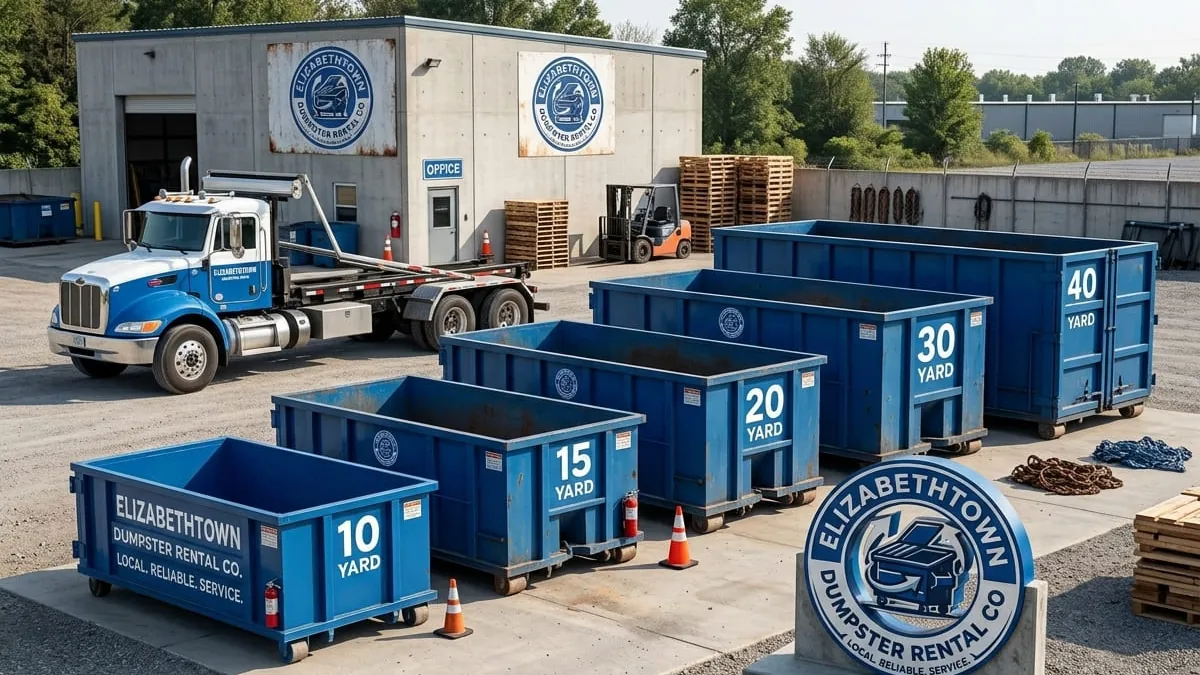
Compare all five sizes
Dumpster Sizes in Elizabethtown, KY — 10, 15, 20, 30 & 40 Yard
Two things decide the size in this county, and neither of them is how big the pile looks from the back door. The first is what the debris weighs: limestone and concrete rubble, block and mortar, footing spoil, and a tear-off counted in squares and layers, all weigh a great deal more than they read. What the box will be standing on is the other half of it. A short drive on an older street inside the city limits, a long gravel approach on a county lot, or a wet two weeks in a county with no dry season all settle the placement long before volume gets a say in it.
All sizes
Weight sets the box, volume only settles the rest
The table scrolls sideways on a phone. Anything with concrete, limestone, block, brick, mortar, footing spoil or shingle in it belongs at the 10 or the 15 no matter how the pile reads from the yard, because those boxes fill by weight a long time before volume comes into it. Three things about Hardin County will be missing from a sizing chart written for somewhere else. First, what Kentucky itself counts as construction debris. The Commonwealth writes the definition down at 401 KAR 47:005 — “waste resulting from the construction, remodeling, repair, and demolition of structures and roads, and for the disposal of uncontaminated solid waste consisting of vegetation resulting from land clearing and grubbing, utility line maintenance, and seasonal and storm related cleanup” — and the part people miss is the second half. Land clearing and storm cleanup are inside the definition, which is precisely the material the City’s free brush round is written to exclude, so it arrives in a container instead. Second, where the work actually is. Owner-occupancy inside the Elizabethtown city limits runs 49.3 percent against 62.6 percent across Hardin County, and about two in five county homes were built before 1980 — so a city job is more often a turnover or a clear-out on a tight lot, and a county job more often a renovation with an outbuilding attached to it. Those are not the same box. Third, what the box is allowed to stand against, and who is entitled to look at it. On a driveway at a house, Kentucky’s state fire code does not reach the container at all: 815 KAR 10:060 adopts NFPA 1, Uniform Fire Code, 2018 edition, whose combustible waste and refuse provisions sit in Chapter 19, and § 2(1) of that regulation says it “shall apply to all buildings except one (1) and two (2) family dwellings.” Put the same box tight against a store, a restaurant, a warehouse or an apartment building and it does apply — and the people who will actually come out and look are Elizabethtown Fire Prevention on (270) 765-2121. We publish no clearance distance for Kentucky, because we could not verify one, and a figure lifted from another state’s fire code would be worse than no figure at all.
| Size | Capacity | Box size | Weight allowance | Roughly equal to | Suits |
|---|---|---|---|---|---|
| 10 Yard Dumpster | 10 yd³ | 12 x 8 x 3.5 feet | 2 to 3 tons | around 3 pickup loads | Broken driveway, block and footing spoil. Limestone is dense: this one is full by weight long before it looks it. |
| 15 Yard Dumpster | 15 yd³ | 16 x 8 x 4 feet | 2 to 3 tons | around 4 to 5 pickup loads | A single-layer tear-off, or one room of a 1970s Hardin County house stripped to the studs. |
| 20 Yard Dumpster | 20 yd³ | 22 x 8 x 4.5 feet | 3 to 4 tons | around 6 to 8 pickup loads | What leaves the North Dixie yard most weeks — an attic, a garage and a basement in one go. |
| 30 Yard Dumpster | 30 yd³ | 22 x 8 x 6 feet | 4 to 5 tons | around 9 to 12 pickup loads | A whole-floor remodel, forty years of one family’s storage, or a June turnover. No shingle, ever. |
| 40 Yard Dumpster | 40 yd³ | 22 x 8 x 8 feet | 5 to 6 tons | around 12 to 16 pickup loads | Light, bulky material only, and it needs the longest straight approach of anything on this list. |
10 Yard Dumpster
Broken driveway, block and footing spoil. Limestone is dense: this one is full by weight long before it looks it.
View this size → 15yd³15 Yard Dumpster
A single-layer tear-off, or one room of a 1970s Hardin County house stripped to the studs.
View this size → 20yd³20 Yard Dumpster
What leaves the North Dixie yard most weeks — an attic, a garage and a basement in one go.
View this size → 30yd³30 Yard Dumpster
A whole-floor remodel, forty years of one family’s storage, or a June turnover. No shingle, ever.
View this size → 40yd³40 Yard Dumpster
Light, bulky material only, and it needs the longest straight approach of anything on this list.
View this size →Two rules, in this order
Weight runs out before room does — and what the box stands on outranks both
Read this paragraph if you read nothing else here. Every container has two ceilings over it: the room between its walls, and the weight a truck may lawfully lift off your drive and carry to a facility. Light bulky debris finds the first ceiling. Dense material finds the second one, and a great deal sooner than anybody plans for.
The dense material in this county is limestone and concrete rubble, block and mortar, footing spoil and shingle. A front walk, a patio, a section of garage slab, a chimney or a length of old block wall gets to lawful transport weight while the can still looks part-used, which is why every one of those jobs starts at a 10 or a 15 and stays there. Dug ground is the thing people misjudge most, and we are not going to help by inventing a figure for it. We could not verify a frost depth, a soil series or a bearing capacity for Hardin County from any source worth quoting, so this site publishes none of the three — for a city address that question belongs with Elizabethtown Planning and Development on (270) 765-6121, and for a county address with the Hardin County Planning and Development Commission on (270) 769-5479. What is safe to say is that spoil neither settles nor compresses, so a trench for a footing, a lateral or a water service throws off more material than the hole suggests and every bit of it is heavy. Then the roof. It is counted in squares and layers and never by area, and on this county’s 1970s stock — the single biggest decade in Hardin County at 16.2 percent of the housing — a second course still nailed to the deck is ordinary rather than exceptional, which doubles the tonnage on a job that read as one box. Roofing never goes in a 30 or a 40 here. Water belongs in the same paragraph, because in this county it is a weight problem rather than a nuisance: there is roughly fifty inches of rain in an average year and no dry season to schedule around, May is the wettest month at about 5.82 inches and it is also when renovation season starts, and September is the driest at about 3.14 inches while still being mild, which makes it the best month in the year to take something apart outdoors. A container left open through a wet week collects water, water is weight, and weight is what disposal is measured on.
Sorting still pays, and in Kentucky it pays for reasons you can actually check. Tires are the one disposal restriction the Commonwealth writes for itself. Under KRS 224.50-856 waste tires may be disposed of only “by transfer to a permitted solid waste disposal facility,” and moving more than fifty of them puts a person inside the state’s waste tire transporter rules. The City’s own free clean-up refuses tires as well. Past tires we will not tell you Kentucky bans anything from a landfill, because we could not verify that it does. What Hardin County offers instead is a calendar: a household hazardous waste event once a year and an electronics recycling event once a year, plus seven around-the-clock drop-offs that take four narrow streams — rinsed #1 and #2 plastics, rinsed aluminum and tin, non-greasy cardboard and newspaper — under the county’s own flat sentence, “items not listed above are not accepted at any drop-off location.” County Solid Waste is (270) 360-9207. Liquids never ride in a container here, and the reason is under your feet: paint, oil, antifreeze, solvent and pool chemicals move fast through limestone, and the City’s own clean-up refusal list names “hazardous materials, liquids (paints, oil, antifreeze, etc.)” in the same breath as construction debris. One last piece of Kentucky arithmetic that is worth knowing and is not a price: the Commonwealth charges an environmental remediation fee of $1.75 a ton under KRS 224.43-500, and it funds the Kentucky Pride Fund, which pays to close old landfills and clear illegal open dumps. Every legally disposed ton pays into that. Every ton tipped down a bank does not. Kentucky also permits its disposal sites in classes — contained, construction and demolition debris, inert, residual and special waste — so “where does it go” genuinely has a different answer for a kitchen strip-out than for a roof tear-off, and a load kept clean has more places it can lawfully go. Ours leave for a permitted Kentucky disposal facility with the metal and the flattened cardboard already pulled out.
The second rule is the one no sizing chart carries. What the box stands on matters as much as which box it is. This is limestone country — the Kentucky Geological Survey names Elizabethtown among the karst cities of the Western Pennyroyal — and there are four things we will not do with that fact. We will not tell you a loaded truck causes a sinkhole, because no agency says so and KGS attributes collapse to moving water and to soil piping down into the rock. We will not read a map and pronounce on your property, because KGS says of its own sinkhole data that it is “not recommended for predicting future subsidence.” We will not publish a karst percentage or a sinkhole count for this county, because no honest one exists to publish. And we are not geologists, which is the shortest of the four and the one that matters. What we do instead is what KGS advises any Kentucky owner to do before choosing a spot: walk the lot for “shallow depressions and arch-shaped cracks in the soil,” look at doorframes and windows for squareness, and if you bought the house, ask what was ever filled and where. Then the practical part. Dry, this ground takes a loaded container as well as any ground in the country. Soft — after a wet week, after a thaw — and several tons standing on four small pads will press in and stay in the impression. So it is concrete rather than turf, with plywood under every wheel and both rails on every drop, twelve months of the year. Load it flat and low: heavy underneath, nothing standing proud of the rail, because anything proud of the rail cannot be covered and will not be collected until it has been leveled. The 30 and the 40 yard earn their keep on bulk that carries no weight — a shed, a deck or an outbuilding coming down, a whole-house clearance, an attic and a garage emptied after forty years — and they want more room to land than anything else we run.
Tell us what the material is, roughly how much of it there is, and what the box will be standing on. The size comes back on the phone, and it comes back honestly — a container that has to be split or part-emptied costs us a truck movement, and truck movements are the expensive part of this business.
How it works
From the phone call to an empty driveway, in four steps
- 1
Tell us the job
Two minutes, and a street name and a nearest crossroad is enough. Tell us the address rather than the mailing town — on this side of Elizabethtown the two are not always the same thing. You hang up with a flat number that has the disposal inside it.
- 2
We set it down
The driver walks the approach first and puts plywood under both rails and every wheel. Where the box stands tight against a commercial building, the fire officials with jurisdiction at that address are the people who will actually look at it — inside the Elizabethtown city limits, that is Fire Prevention on (270) 765-2121.
- 3
Fill it flat and low
Use the days in your window. Heavy on the bottom, nothing standing proud of the rail, and keep it covered — there is no dry season here, and water is weight.
- 4
Say the word
Ring and we pull it. Metal and cardboard come out on the way, and the rest goes to a permitted Kentucky disposal facility.
Choosing a Size — FAQs
Which dumpster size is most popular in Elizabethtown?
The 20 yard, and not narrowly. It is the default for a whole-house declutter here: an attic, a garage and a spare room going out inside the same two weeks, with sides low enough to load over on most of it and a footprint that still fits an ordinary drive. Behind it, the 15 is the box this market quietly runs on — right for a single-layer tear-off on an average house, right for one room taken back to the studs, right for a rental turnover. Anything carrying concrete, limestone, block, mortar or trench spoil travels the other way, down to a 10 yard. Two local patterns move the mix around during the year. Inside the city limits, where fewer than half of occupied homes are owner-occupied, turnovers and landlord clear-outs never really stop. And summer has an Army in it: Fort Knox is a headquarters post whose people largely live off post, and the Army’s own published window is that “PCS season runs from June to August and potentially into September” — a moving season with a hard report date attached to it. We publish no figure for how many of those moves happen and never will; we simply keep more 20s on the lot between June and September.
What size do I need for a roof tear-off?
A 15 yard for a single-layer tear-off on an ordinary Elizabethtown house, and a 20 the moment a second layer or the decking comes off with it. Roofing does not go in a 30 or a 40 here, ever. A tear-off is a weight job wearing the clothes of a volume job, so it is settled by squares and layers and never by the area of the roof — and with the 1970s the biggest single decade of housing in Hardin County, a second course still on the deck is ordinary. Where a job is genuinely bigger than a 20, the answer is a second pull booked before the crew starts, not a taller box. Two things can stop a tear-off before it starts, and both are worth settling in advance. Asbestos can be in old felt, mastic and cement-based shingle. Kentucky runs the federal standard through 401 KAR 58:025, notification goes to the Division for Air Quality through the Cabinet’s eForms system as Form ID 70 at least ten working days ahead, and a demolition is notifiable whether or not asbestos is present. The Cabinet’s own page also says that removal and disposal from “single-family homes or apartments of four or less units is not regulated under Kentucky law” — read that for exactly what it is, a statement about notification, and not a statement that the material is safe, that no federal rule applies, or that a facility will take it unannounced. Test before you demolish. The Division for Air Quality is (502) 564-3999. Lead is the other one: the federal renovation, repair and painting rule turns on pre-1978 housing, and Kentucky is not one of the states authorized to run that program, so certification for it comes from EPA directly — lead abatement is the half Kentucky does run itself. The full arithmetic is in our roof tear-off sizing guide.
Is the 40 yard just the biggest and best?
No — and assuming otherwise is one of the more expensive assumptions in this trade. The 40 is a volume container for light bulk: framing, cabinetry, decking, packaging, a house cleared out wholesale. Fill it with anything dense and the lawful transport weight turns up while three quarters of the box is still empty, and a tear-off should not go anywhere near one. It also wants more room to land than anything else we run, which rules it out on plenty of the older streets inside Elizabethtown where lots are narrow and drives are short, and on any property where the only level ground is unpaved. An open box of light material has to sit below the rails and stay covered, and in a county with no dry season that is as much about rain as it is about wind: a 40 left open through a wet week is carrying water you will pay to haul. Where room is tight we would rather run two smaller boxes through than wedge one large one in, and it usually works out better for everybody.
Can I change size after I book?
Yes, right up until the truck leaves the yard. And where what you describe does not match what you have asked for, that conversation happens on the phone rather than in your driveway on the morning of the job. A change made in conversation costs nothing; the same discovery made at a scale house costs a good deal more.
How much room does the truck actually need?
More than the box takes up, and the part people underestimate is the approach rather than the footprint. Reckon on about 60 feet of straight, level approach for the truck to back in, roughly eleven feet of working width, and 20 feet or more of clear air overhead while the hoist is up. Surface matters as much as room. Say what the spot is — concrete, asphalt, gravel, grass — and whether it stays soft for a day after rain, because soft ground will not carry a loaded box and a dry drive will. On fire clearance the honest Kentucky answer has two halves. At a single-family house or a duplex the state fire code does not reach the container at all, because 815 KAR 10:060 § 2(1) applies the Kentucky Standards of Safety “to all buildings except one (1) and two (2) family dwellings” — the combustible waste and refuse provisions of NFPA 1 (2018), Chapter 19 are written for the buildings it does reach. Against a commercial or multifamily building it applies, and Elizabethtown Fire Prevention on (270) 765-2121 are the people who will look at it. Two more numbers worth keeping straight. § 154.135(F) of the City’s zoning code sets the standard for permanent trash areas on commercial and multifamily sites — not visible from a street, and no closer than 20 feet to any street, public sidewalk or pedestrian walkway. That is a development-plan standard for a built enclosure; it is not a rule that a temporary container has to sit twenty feet back from the street, and for a container during a project the right move is a call to Planning and Development on (270) 765-6121 first. And if any part of the box has to stand in a city street or on a sidewalk, ring the City and ring Public Works on (270) 737-7890 before the truck rolls, because the driveway rules do not travel into the roadway. If the frontage is a numbered route — US 31W, US 62, US 31E, I-65 or the parkways — that right-of-way belongs to the Kentucky Transportation Cabinet rather than to the City, and the local desk is KYTC District 4, 310 Valley Creek Road here in Elizabethtown, (270) 766-5146. Last, look upward before you settle on a spot: the service drop feeding the house, a low gutter, a porch roof or a mature limb over the drop point will stop the arm dead where nothing at ground level would have.
When should I book, and does the season change the answer?
Sooner than you think in two windows, and the reasons are local rather than commercial. May is the wettest month here at about 5.82 inches, and it is also when renovation and roofing season gets going — the two arrive together, which is why a cover on the load in May is worth more than an extra yard of box. September is the driest month at about 3.14 inches and still mild, and for taking something apart outdoors it is the best month in the year in this county. Between those, summer is the tightest stretch on the board: the Army’s own published window is that “PCS season runs from June to August and potentially into September”, and Fort Knox is a headquarters post whose people largely live off post, so move-outs, move-ins and rental turnovers stack up across the same weeks. We publish no figure for how many of those moves happen, and we never will. Spring adds a third pattern: the City’s free clean-up ran in 2026 as “March 30th thru May 1st — junk and debris”, which is when a great many households look properly at what is in the garage — and then discover that the published refusal list names “construction debris”, tires, liquids and hazardous materials. Those dates move each year, so confirm the current ones with Public Works on (270) 737-7890. Winter is quieter and the risk is ice rather than snow depth; a glazed sloping driveway is a real reason a delivery gets moved a day. Ring (270) 900-6891 with a date in mind and we will tell you honestly how tight that week looks.
Services
What people around here are putting in them
Residential Dumpster Rental
Two in five Hardin County houses predate 1980, and their attics and garages show it.
Learn more →Commercial Dumpster Rental
Businesses inside the limits, where Fire Prevention on (270) 765-2121 will look at the box.
Learn more →Construction Dumpster Rental
Mixed build waste in one box, swapped next day, from the city line out to the county roads.
Learn more →Roofing Dumpster Rental
Squares and layers, never roof area — and never a 30 or a 40, whatever the roofer asks for.
Learn more →Roll-Off Dumpster Rental
Five box sizes, out of the North Dixie Highway yard every working day of the week.
Learn more →Same-Day Dumpster Rental
Call before nine and the afternoon board usually still has a slot on it.
Learn more →Talk to a real person
Not sure which size you need?
Give us the street address rather than the mailing town, say what is going in, and you will have the size, one flat figure and a day before you hang up. Nothing on this site to fill in, and nothing waiting in an inbox overnight.
Elizabethtown, the rest of Hardin County, and seventeen more places across seven counties · Mon–Fri 6:30am–5pm, Sat 7am–1pm