
Local Guide
Fort Knox PCS Move-Out Cleanouts in Hardin County
A family with orders and a hard report date, and the family that just bought their house sight unseen. Both halves of the Fort Knox move cycle, and the one Hardin County disposal problem that runs on an annual calendar.
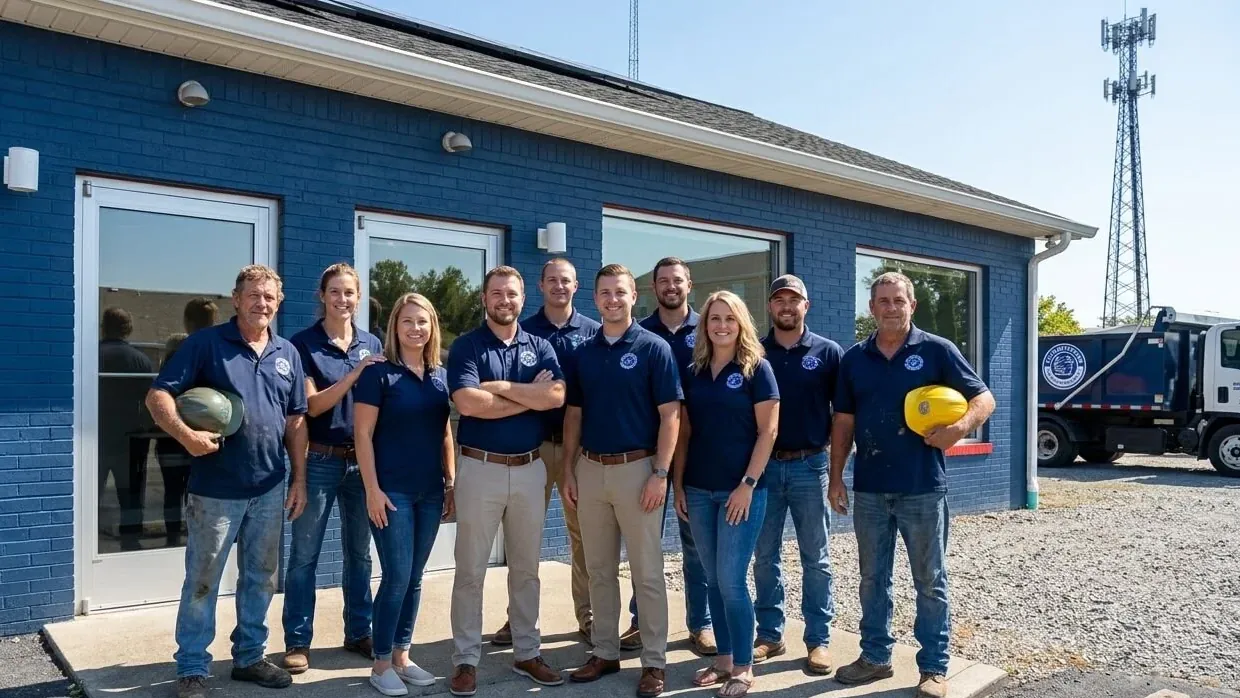
Somewhere in Hardin County this week, a family is looking at a report date on a piece of paper and doing arithmetic. The house has to be empty. The garage has to be empty. The storage unit nobody has opened since the last move has to be empty. And there is a date, and the date does not move.
This page is written for that situation, not for the uniform. It is also written for the other half of the same cycle, which almost nobody writes about: the family that just bought a Hardin County house from three states away, on photographs, and is now standing in a basement full of somebody else’s forty years.
First, the things we are not going to say. We are not affiliated with the installation. We are not endorsed by it, approved by it, or connected to it in any way, and we do not operate on post. Fort Knox is federal land. City and county rules do not apply there, the installation sets its own, and anything happening inside the gates is a question for the garrison, not for us. Everything below is about the houses, apartments and rentals off post, in Elizabethtown, Radcliff, Vine Grove and unincorporated Hardin County, where city and county rules do apply and where we can actually be useful.
The calendar, in the Army’s own words
We are not going to invent a Fort Knox move-out statistic. Nobody publishes one, and we could not find one. What the Army does publish, plainly, is its own peak season:
“Annually, PCS season runs from June to August and potentially into September.”
That is the Army describing its own permanent-change-of-station cycle across the force. The same Army guidance tells soldiers and civilians to “contact the local transportation office as soon as orders are received,” and warns that waiting until thirty days or less before the move can leave you without an approved moving company available.
Now put that next to what Fort Knox is. It spans parts of three Kentucky counties — Bullitt, Hardin and Meade — and covers about 109,000 acres. It is a principal city of the Elizabethtown metropolitan area, alongside Elizabethtown itself; this is its own metro, not the edge of somebody else’s. And it is a headquarters post: Human Resources Command, Cadet Command, Recruiting Command and V Corps are all based there. A headquarters population is heavily permanent-party and heavily civilian, and a great deal of it lives off post — the Fort Knox census-designated place counted 7,742 people in 2020, down from 12,377 in 2000, while the surrounding county kept growing.
The published local economic figures come from the Knox Regional Development Alliance and a column in The News-Enterprise, not from the Department of Defense, and we cite them as such: “more than 16,000 people … work at Fort Knox each day,” around $750 million in annual payroll, roughly 27,000 jobs off post, and a $2.6 billion annual impact.
And the Census puts the demographic signature on it: 12,344 veterans in a county of about 113,000 — roughly one resident in nine, before you count anybody currently serving. Inside the Elizabethtown city limits, 49.3% of occupied homes are owner-occupied. County-wide it is 62.6%. The city is the rental half of this market, and the rental half is the half that turns over on somebody else’s schedule.
Draw your own conclusion about what June through September looks like around here. We are not going to draw it for you with a number we cannot source.
One correction, because locals notice
While we are being careful: the United States Bullion Depository — the gold vault — is a Treasury facility, guarded by the United States Mint Police. It is not an Army building and the Army does not guard it. It sits next to the post, which is why the whole country gets it wrong. People who live here do not.
Half one: you are leaving
Do the liquids first, not last
This is the single most important paragraph on this page, and it is the one nobody expects.
Ask your transportation office early what the movers will not pack. There is always a list, and it always includes things like open liquids, fuels, aerosols and pressurized cylinders. Whatever comes off that list is now your disposal problem, and in Hardin County the disposal route for that category is an annual event, not a place.
Hardin County runs a Household Hazardous Waste collection event once a year — paint, chemicals, batteries, pesticides, cleaning supplies — and an electronics recycling event once a year, for computers, televisions, phones and printers. Those are the county’s own recommended routes. The county also runs seven drop-off locations open around the clock — Eastview, Elizabethtown, Farmers Market, Glendale, Radcliff, Sonora and Vine Grove — but those take only four narrow streams: rinsed #1 and #2 plastics, rinsed aluminum and tin cans, non-greasy cardboard, and newspapers. The county’s own wording is blunt: “Items not listed above are not accepted at any drop-off location.”
So if your orders put your move in July and the household hazardous waste event is not in July, the half-can of deck stain and the jug of antifreeze have nowhere to go on your timeline. That is not a container problem — none of that goes in a container anyway — it is a calendar problem, and the time to solve it is the week the orders come in, not the week the truck comes.
Call Hardin County Solid Waste on (270) 360-9207 and ask when the events are. The county also publishes them on its own free-disposal-events page and you can get alerts by texting “hardincounty” to 91896. We are not going to print a date here, because a stale date is worse than no date.
And do not count on the City’s spring clean-up to solve it either. The City of Elizabethtown’s clean-up for 2026 is published as March 30 through May 1 for junk and debris, with appliances collected April 27 through May 1 on a call-in basis. That window closes before PCS season opens. It also refuses, in the City’s own words, “No garbage, hazardous materials, liquids (paints, oil, antifreeze, etc.), construction debris, tires, or automobiles.” Confirm current dates with Public Works on (270) 737-7890; they move every year.
The rest of it, in the order that works
- Storage unit first, house second. The storage unit is where the surprises live, and it is the one place you can work on without disrupting the household. Empty it before the movers arrive, not after.
- Then the garage, the attic and the shed. These are where the volume is. A move-out container is filled mostly by things that were never going to move again anyway: the swing set, the deck furniture that did not survive, the workbench, the paint-spattered dropcloths, the second grill.
- Then the interior. By the time you are inside the house, you should already know how much room is left in the box.
- Tires last, and separately. Kentucky regulates waste tires on their own track. Under KRS 224.50-856, waste tires may be disposed of only “by transfer to a permitted solid waste disposal facility,” and moving more than fifty of them brings you inside the Commonwealth’s waste tire transporter rules. Four tires behind the shed is an ordinary find in this county. They do not go in a general container. Set them aside and ask.
Size, honestly
For a whole-house move-out the working default is a 20-yard container. A 15 is right for an apartment or a townhouse turnover, or for a house where most of the contents are actually moving. A 10 is for a single room, a garage, or a driveway that will not take anything longer. Going bigger than a 20 on a household cleanout is usually a mistake — not because of volume, but because a big box invites people to put heavy things in it, and heavy things are what stop a truck. If in doubt, tell us the square footage and how full the garage is. That is genuinely enough information.
The full range is on the sizes page, and the sizing guide goes through it properly.
The code details that actually bite on a move-out
Inside the Elizabethtown city limits, three lines of the City’s code matter more on a move-out than on any other kind of job.
- § 92.031(A) makes it a violation to leave “any garbage or other material subject to decay for more than 96 consecutive hours, except in a tightly-covered metal or plastic container.” The contents of the refrigerator and the chest freezer are exactly that. They do not go in the roll-off, which is going to sit on the driveway for several days with a lid you open all day long. Bag them and put them out with the weekly collection.
- The City does not collect household garbage. § 92.031(H)(1) lists the lawful methods and the first is “Pickup and collection by sanitation companies, who possess a valid business license.” If you are ending a lease, do not cancel the trash service before the last day. People do it constantly and then discover the fridge is still full.
- § 92.031(E) makes it a violation to dump garbage, debris or rubbish on any premises in the city “with or without the consent of the owner.” Leaving the mattress at the curb of a house you have already handed back is not a gray area.
And § 92.030 is the one that gives all of that teeth: “Violation of this subchapter shall be deemed a public nuisance.”
Which government is yours
This is the part that catches people who have moved five times and never had to think about it, because in most of America the answer is the same everywhere. Here it is not. Radcliff, Vine Grove and Elizabethtown are separate cities with separate halls, and unincorporated Hardin County has no city hall at all. A rental on one side of a line and a rental on the other are two different jurisdictions.
- City of Elizabethtown — (270) 765-6121; Public Works (270) 737-7890.
- City of Radcliff — (270) 351-4714. Ask them; we do not publish other cities’ rules as though they matched Elizabethtown’s, because we have not verified that they do.
- City of Vine Grove — (270) 877-2422.
- Unincorporated Hardin County — Hardin County Planning & Development Commission, (270) 769-5479.
- Fort Knox — federal land, installation rules, and none of the above.
The city line guide explains why this market works that way, and it is a better story than you would expect.
Half two: you are arriving
The other half of PCS season is a house that was bought on photographs and a video walk-through, closed in eleven days, and handed over with the sellers’ own move still half-finished. In a garrison county that is not unusual. It is a Tuesday.
What is left behind tends to be the same short list every time: the basement, the attic, the shed, the paint shelf in the garage, and — out in the county — an outbuilding nobody mentioned.
Before you start pulling things apart
About two in five homes in Hardin County were built before 1980 — roughly 38.6% of the stock, per the American Community Survey’s 2019–2023 estimates — and the single biggest decade is the 1970s. That is a Fort Knox-era build-out that is now at the age where roofs, kitchens, bathrooms and HVAC are all on their second or third replacement. Two rules attach to houses of that age, and Kentucky handles them differently from most states:
- Lead. The federal renovation, repair and painting rule applies to paid work that disturbs painted surfaces in housing built before 1978. Here is the part that catches people: Kentucky is not one of the states authorized to run its own RRP program. Certification comes from EPA directly. Kentucky does run lead abatement certification itself, through its own Environmental Lead Program, and those two things are not the same thing. If a contractor tells you they are “state certified” for RRP in Kentucky, ask a second question. The National Lead Information Center is 1-800-424-5323.
- Asbestos. The Energy and Environment Cabinet’s own asbestos page says that removal and disposal from “single-family homes or apartments of four or less units is not regulated under Kentucky law.” Read that for exactly what it is: a statement about notification. It does not mean asbestos in a house is safe, that no federal rule reaches it, that OSHA does not apply to whoever swings the hammer, or that a facility will take it unannounced. Test before you demolish. The Division for Air Quality is (502) 564-3999.
And while you are down in that basement: Hardin County is in EPA radon Zone 2, and EPA’s own caveat travels with that: “No matter where you live, test your home for radon.” All homes should be tested regardless of zone. A basement remodel that opens up a slab is the natural moment to do it. More at EPA.
What the previous owner left, and where it goes
The same annual-event problem applies in reverse. The paint shelf in the garage you just bought is now yours, and the county’s route for it is still an event, not a place. Inventory it in week one.
Everything that is genuinely just debris — the failed shelving, the carpet, the panelling, the shed that has been leaning since 2011 — is straightforward. Kentucky’s own regulations define construction and demolition debris broadly, and the definition is worth knowing: “Waste resulting from the construction, remodeling, repair, and demolition of structures and roads, and for the disposal of uncontaminated solid waste consisting of vegetation resulting from land clearing and grubbing, utility line maintenance, and seasonal and storm related cleanup.” Note the word uncontaminated. A load with a leaking fuel can in it is not that.
One more thing for anyone who has landed on acreage out in the county: do not bury it. Elizabethtown, Fort Knox and Munfordville are all named by the Kentucky Geological Survey among the karst cities of the Western Pennyroyal region, and karst means water moves fast and unfiltered through the ground under you. The karst guide covers what that does and does not mean for where a container sits.
Booking, and the weather that decides the week
June through September is our busiest stretch, for exactly the reason this page is about. Book earlier than feels necessary. A day’s notice in February is fine; a day’s notice in the second week of July is optimistic. If you truly have no notice, same-day service is sometimes possible — call and ask rather than assume.
Two weather facts that matter on a hard deadline. First, there is no dry season in Hardin County: it rains a little under fifty inches a year here and it is spread across every month, so a container left open for a week will catch water, and water is weight. Keep it covered. Second, if you have any say at all in your timing, September is the driest month of the year here and still mild — a little over three inches of rain against a little under six in May, which is the wettest. September is the best month in the calendar for emptying a house in this county.
The short version
- The Army says its PCS season runs June to August and potentially into September. Plan against that, not against our guess.
- Do the liquids first. Hardin County’s household hazardous waste and electronics routes are annual events, and the everyday drop-offs take four narrow streams only. (270) 360-9207.
- Nothing hazardous, no liquids, no tires in the container. Tires are the one Kentucky-specific disposal rule we can point to.
- 20-yard for a house, 15 for an apartment or townhouse turnover, 10 for a garage or a tight drive.
- Don’t put the freezer contents in the roll-off — § 92.031(A), 96 hours. Don’t cancel the trash service early.
- Know which government you are standing in. Elizabethtown, Radcliff, Vine Grove and the unincorporated county are four different answers.
- Fort Knox is federal land. We do not operate on post and we claim no connection to it.
Call (270) 900-6891 with the address, the report date and roughly how full the garage is, and we will tell you the size and the day. More on junk removal, on residential containers, and in the estate cleanout checklist, which is the same job at a slower pace. Fort Knox publishes its own information at home.army.mil/knox.
Questions this guide did not answer? Call (270) 900-6891. We would rather spend two minutes on the phone than have you order the wrong container.