
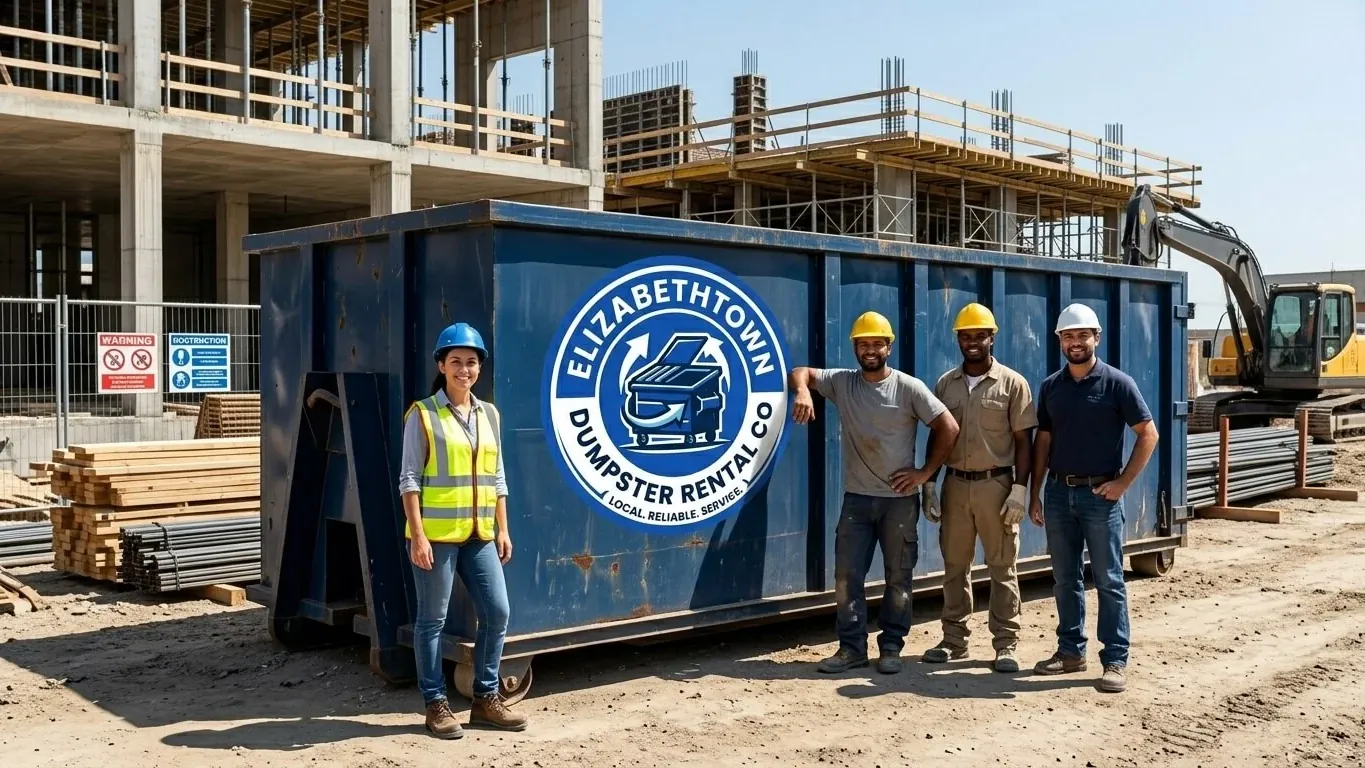
Construction
Construction Dumpster Rental in Elizabethtown, KY
Containers and booked swaps for builders, remodelers and trades across Hardin County — in a Commonwealth that writes one building code for everybody and then lets your town decide whether your house counts.
If you have built in a state where every town writes its own rules, Kentucky will feel unusually tidy. KRS 198B.050 requires the Commonwealth to adopt and promulgate a mandatory Uniform State Building Code establishing standards for the construction of all buildings in the state. There is one code and Frankfort writes it. The current pair is the 2018 Kentucky Building Code at 815 KAR 7:120, now in its fourth edition of February 2024, and the 2018 Kentucky Residential Code at 815 KAR 7:125, third edition of August 2024, both effective 3 December 2024. Elizabethtown does not have a building code of its own; it enforces the Commonwealth’s, and says so at § 150.01(A). The Department of Housing, Buildings and Construction publishes the codes at dhbc.ky.gov.
Then comes the part that is genuinely local and that almost nobody gets right. KRS 198B.060(8) provides that nothing in it shall require a single-family dwelling to be permitted or inspected “unless a local government has established a building inspection program.” In much of unincorporated Kentucky, that means a house does not automatically need a local permit. Elizabethtown deliberately opted in. At § 150.01(C) the City code says a building inspection program “is hereby established in the city for application to all buildings, including single-family dwellings.” So the answer to “do I need a permit for this house job” changes at the city line, and it changes in the direction most people would not guess. Inside Elizabethtown, the City runs an inspection program that reaches houses. Outside it, ask the Hardin County Planning and Development Commission on (270) 769-5479, because whether the county’s program reaches single-family dwellings is a question we could not answer from published sources and will not guess at.
Elizabethtown’s fee schedule has two figures worth knowing before you plan a job. As published in the City’s code at § 150.16, a construction permit for work under $10,000 in declared value carries no fee — which is not the same thing as no permit, and people conflate the two constantly. Above that there is a published sliding scale that runs up to $10,000 for work over five million. A residential demolition permit is $50 and a commercial one is $100. Those are figures as published in the code current through Ord. 22-2025; confirm current fees with Planning and Development on (270) 765-6121 before you rely on them. One more from the zoning side: § 154.011 requires construction and demolition permits and provides that a permit becomes void if work is “suspended or abandoned for a period of six months.” On a stalled job that is a real deadline, not a formality.
The market itself has been through something unusual. Glendale is the site of what was announced as the largest economic development investment in Kentucky’s history — a $5.8 billion battery campus on 1,500 acres, ten miles south of Elizabethtown. The EV battery joint venture ended in December 2025 and around 1,600 people lost their jobs; Ford has since committed a further $2 billion to retool the plant for grid-scale energy storage, with production planned to restart in late 2027. Whatever the eventual outcome, Hardin County has spent five years absorbing the construction, the housing demand and now the disruption of a project on that scale. For a builder the durable point is not the plant. It is that the county’s trade capacity, its subcontractor pool and its housing pipeline have all been moving fast in both directions, and schedules here have been harder to hold than the drawings suggest.
Practically: book swaps rather than one large container, tell us the surface and the approach, and get the locate in before anybody digs. Kentucky 811 wants two full working days notice, the ticket is good for 21 calendar days, and the tolerance zone is 18 inches either side of the mark, inside which you hand-dig. Dial 811 or use kentucky811.org. Call the yard on (270) 900-6891 and we will put the containers on the program with you.
The Construction Jobs Hardin County Produces
New Construction And Additions
Framing offcuts, sheathing, housewrap, siding trim, window and door packaging, banding and the endless cardboard. Light for its volume, so it wants a 30 rather than a heavy box — and keep the trench spoil out of it entirely, because soil will hit payload on its own.
Whole-House Or Whole-Floor Remodel
Plaster, lath, drywall, cabinetry, flooring, tile, trim and old mechanicals coming out together. In a Hardin County house from the 1970s, expect a second layer of everything and plan the lead and asbestos questions before the first wall opens.
Roof, Siding And Window Replacement Packages
Three trades and three very different densities. Shingle is heavy and belongs in a small box loaded flat; siding and window packaging are bulky and light. Running them through one container is how a job ends up with a load that cannot lawfully leave the site.
Interior Strip-Out For A Tenant Fit-Out
Partitions, ceiling grid, carpet tile, millwork and services. On a commercial building this is inside the state fire code’s scope and, for anything with asbestos-containing material in it, inside the Commonwealth’s notification rules — both of which have lead times.
Concrete Removal And Site Works
Driveways, aprons, walks, footings and paving. This is a weight job and it wants its own container: a 10 yard loaded flat across the whole floor. Keeping it clean also keeps its disposal routes open, which a mixed load loses.
Land Clearing And Site Preparation
Kentucky’s own regulatory definition of construction and demolition debris expressly includes “vegetation resulting from land clearing and grubbing,” so it is not a separate legal category here. The City’s brush program, by contrast, refuses it outright — see our yard waste page.
Punch List, Handover And Final Clean
Protection sheeting, offcuts, packaging, damaged materials and everything the trades left in the garage. A 20 at the end of a job is usually enough, and getting it there the day before handover is worth more than getting it cheaply the week after.
Stalled Or Abandoned Project Clear-Up
Weathered lumber, ruined drywall, rusted fixings and materials that never got installed. Worth knowing before you restart: under § 154.011 an Elizabethtown permit becomes void if the work is suspended or abandoned for six months, so the paperwork may need reopening as well as the site.
Sizing A Container For A Build Or A Remodel
Most construction work is bulky rather than dense, so the default here is bigger than on a residential job. A 30 yard is the standard container for framing, sheathing, packaging and mixed strip-out debris, and a 40 yard earns its keep where the material is genuinely light and the site has room to land it. A 20 yard is the right box on a tight lot, an infill site or a job with a driveway approach rather than open ground. And the moment the load turns mineral — concrete, block, brick, tile in mortar, trench spoil, sod — it belongs in a 10 yard loaded flat, on its own, because a large container full of rubble reaches a lawful road payload while it still looks half empty. Roofing has a firm ceiling that runs the other way: single-layer tear-off in a 15, a large or two-layer roof in a 20, and never a 30 or a 40. On any job producing two densities, take two containers. Compare all five on the sizes page.
20 Yard Dumpster
What leaves the North Dixie yard most weeks — an attic, a garage and a basement in one go.
View this size →30yd³30 Yard Dumpster
A whole-floor remodel, forty years of one family’s storage, or a June turnover. No shingle, ever.
View this size →40yd³40 Yard Dumpster
Light, bulky material only, and it needs the longest straight approach of anything on this list.
View this size →Permits, Locates And Keeping A Site Legal
Four things decide whether a container on a construction site is an asset or an obstruction. First, the locate. A roll-off does not dig, but nearly every job it serves does — footings, piers, posts, laterals, drainage, stumps. Kentucky 811 is the statutory route: notice of not less than two full working days before work begins under KRS 367.4911, a ticket valid 21 calendar days, and a tolerance zone of 18 inches either side of the mark inside which you hand-dig or use non-intrusive means. Dial 811. On marking out the dig area in white beforehand, the statute is conditional rather than absolute — it is expected when the operator asks or when the site cannot otherwise be pinned down — so do it anyway, because it makes the locate better. Second, the ground. On an active site there is usually no finished driveway to put the box on, which means compacted base, temporary matting or plated timber, and a placement chosen while the ground is dry rather than during the wet two weeks that follows. Hardin County has no dry season — about fifty inches of rain spread across every month — so a spot that works in a drought is not the test. Third, the neighbors and the street. If any part of the container, the truck or the material has to occupy a City street or sidewalk, that is a City question on (270) 765-6121 with Public Works on (270) 737-7890; if the frontage is a numbered route, it is KYTC District 4 on (270) 766-5146 and the Cabinet’s encroachment form is TC 99-1 under 603 KAR 5:120. We could not establish that a temporary container is itself a named encroachment in that regulation, so make the call rather than assume in either direction. Fourth, what goes in. Keep tires out entirely — under KRS 224.50-856 waste tires only go to a permitted facility, and more than fifty of them brings the transporter rules into play. Keep liquids, fuel, solvents and paint out, and not as a formality: the Energy and Environment Cabinet describes karst terrain as moving water through underground conduits fast enough to be “sensitive to groundwater pollution”, and Elizabethtown is one of the Kentucky Geological Survey’s named karst cities. A spill on a site here has a shorter route to somewhere it matters than it would almost anywhere else.
Not sure this is your page? Say what the job actually is and we will point you at the right box — including on the days when that means sending you somewhere else on this site entirely. Ring (270) 900-6891.
One flat number
Give us the street address and say what is going in. You get a size, a figure and a day. Nothing to fill in.
(270) 900-6891Sizes that suit it
How it works
Construction Dumpster Rental in four steps
- 1
Tell us the job
Two minutes, and a street name and a nearest crossroad is enough. Tell us the address rather than the mailing town — on this side of Elizabethtown the two are not always the same thing. You hang up with a flat number that has the disposal inside it.
- 2
We set it down
The driver walks the approach first and puts plywood under both rails and every wheel. Where the box stands tight against a commercial building, the fire officials with jurisdiction at that address are the people who will actually look at it — inside the Elizabethtown city limits, that is Fire Prevention on (270) 765-2121.
- 3
Fill it flat and low
Use the days in your window. Heavy on the bottom, nothing standing proud of the rail, and keep it covered — there is no dry season here, and water is weight.
- 4
Say the word
Ring and we pull it. Metal and cardboard come out on the way, and the rest goes to a permitted Kentucky disposal facility.
Construction Dumpster Rental FAQs
Do I need a building permit for this in Elizabethtown?
Probably, and the reason is a deliberate local choice. Kentucky’s KRS 198B.060(8) says nothing requires a single-family dwelling to be permitted or inspected “unless a local government has established a building inspection program” — so in parts of unincorporated Kentucky the honest answer for a house can be no. Elizabethtown established one and wrote it to reach houses expressly, at § 150.01(C): a building inspection program “is hereby established in the city for application to all buildings, including single-family dwellings.” As published at § 150.16, construction permits carry no fee under $10,000 of declared value, then a sliding scale above it — no fee is not no permit. Confirm current fees and requirements with Planning and Development on (270) 765-6121. Outside the city, ask the Hardin County Planning and Development Commission on (270) 769-5479, and do not assume the answer is the same one.
What size container for a new build?
A 30 yard for the shell and the finishes, and a separate 10 yard for anything mineral. New construction debris is packaging, offcuts, sheathing and housewrap: bulky, light and awkward, which is exactly what a tall box is for. Trench spoil, broken concrete and block are the opposite, and putting them into the same container is the single most common way a job ends up with a load that cannot lawfully leave the site. On a larger build, book swaps at the outset rather than calling when the box is full — a crew standing around waiting for a truck costs more than the extra pull. Tell us the ground conditions and the approach when you book, because on an unfinished site the surface decides everything. Ring (270) 900-6891.
Is there a Kentucky rule about what counts as construction debris?
Yes, and it is unusually clear. 401 KAR 47:005 defines construction and demolition debris as “waste resulting from the construction, remodeling, repair, and demolition of structures and roads, and for the disposal of uncontaminated solid waste consisting of vegetation resulting from land clearing and grubbing, utility line maintenance, and seasonal and storm related cleanup.” Note what that sentence includes: land-clearing vegetation and storm cleanup are inside Kentucky’s definition of C and D debris, where many states class them separately. It matters because the Commonwealth permits disposal facilities in classes — contained, construction and demolition debris, inert, residual and special waste — so “where does it go” genuinely has a different answer for a kitchen remodel than for a slab-out. The regulations are published at apps.legislature.ky.gov.
How does disposal cost work if you will not quote a tipping fee?
We do not publish tipping fees or gate rates, and we would be suspicious of a site that did, because they are commercially specific and they move. What is public, fixed and worth understanding is the Commonwealth’s share: Kentucky charges an Environmental Remediation Fee of $1.75 per ton under KRS 224.43-500 on waste disposed in the state, and it funds the Kentucky Pride Fund — which pays to remediate closed landfills and to eliminate illegal open dumps. Every legally disposed ton pays into it and every illegally dumped ton does not. The practical version for a builder: your disposal cost is driven by weight and material class, not by how full the box looks. Clean loads have routes that mixed loads lose. Ring (270) 900-6891 and describe the material.
The job has stalled. Does anything expire?
The permit can. Elizabethtown’s zoning code at § 154.011 provides that construction, demolition, sign and Board of Zoning Adjustment permits become void if the work is “suspended or abandoned for a period of six months.” So a job parked over a winter can need its paperwork reopened as well as its site cleared. There is a second reason not to let a stalled site sit: § 92.030 declares a violation of the City’s garbage, debris and rubbish subchapter a public nuisance, § 92.031(F) makes failing to dispose of debris “at least one time per week” a violation, and § 92.031(B) requires material that can blow away to be in a covered container. A weathered pile behind a half-finished addition ticks all three. Clear it, then restart the permit conversation with Planning and Development on (270) 765-6121.
More services
Other things we haul
Residential Dumpster Rental
Two in five Hardin County houses predate 1980, and their attics and garages show it.
Learn more →Commercial Dumpster Rental
Businesses inside the limits, where Fire Prevention on (270) 765-2121 will look at the box.
Learn more →Roofing Dumpster Rental
Squares and layers, never roof area — and never a 30 or a 40, whatever the roofer asks for.
Learn more →Roll-Off Dumpster Rental
Five box sizes, out of the North Dixie Highway yard every working day of the week.
Learn more →Same-Day Dumpster Rental
Call before nine and the afternoon board usually still has a slot on it.
Learn more →Junk Removal Dumpsters
Clear a house, an outbuilding or a rental unit at whatever pace the week allows.
Learn more →Estate Cleanout Dumpsters
Patient work for a family emptying a house that one person kept for fifty years.
Learn more →Demolition Debris Removal
Porches, outbuildings and strip-outs — and in the city a demolition permit comes first.
Learn more →Concrete & Heavy Debris
Its own box for slab, block and limestone, loaded flat in a single layer across the floor.
Learn more →Yard Waste & Brush Removal
Its own clean load — the City’s brush round refuses anything from clearing land.
Learn more →Where we deliver
Construction Dumpster Rental across Hardin County and the Lincoln Trail region
Same crew and the same flat rate across all seventeen. Open your own page for the placement notes and for which of the four desks governs the job.
Talk to a real person
Need construction dumpster rental in Elizabethtown?
Give us the street address rather than the mailing town, say what is going in, and you will have the size, one flat figure and a day before you hang up. Nothing on this site to fill in, and nothing waiting in an inbox overnight.
Elizabethtown, the rest of Hardin County, and seventeen more places across seven counties · Mon–Fri 6:30am–5pm, Sat 7am–1pm