
Glendale, KY · Hardin County
Dumpster Rental in Glendale, KY
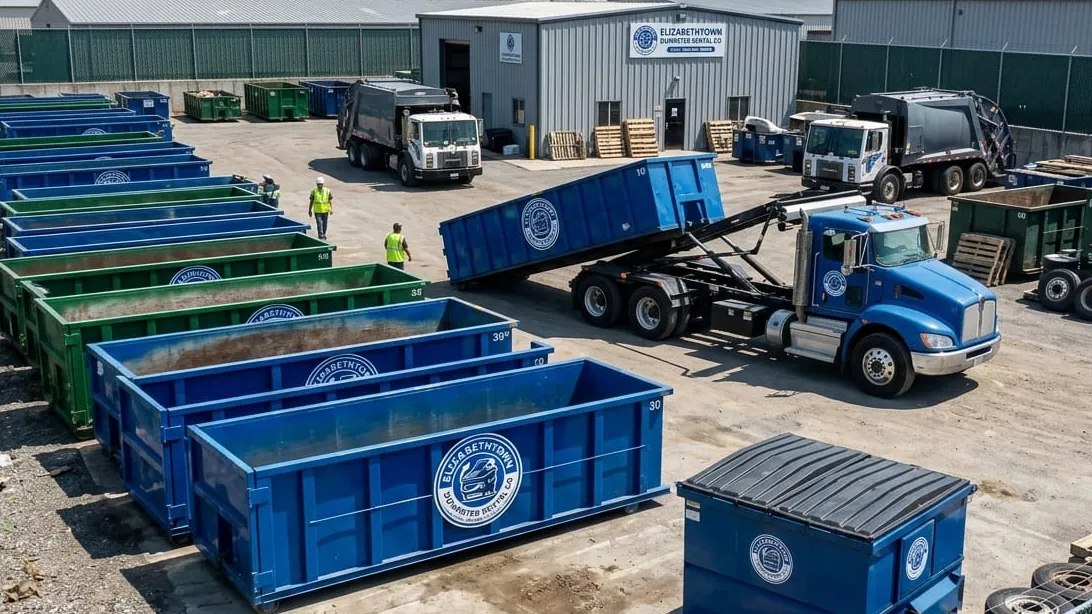
Roll-off containers run out to Glendale from our yard on North Dixie Highway here in Elizabethtown — south of Elizabethtown off the I-65 corridor, a straightforward run from the yard. One flat number with the disposal inside it, plywood under the rails on every drop, and a same-day slot whenever the board still has one.
Roll-off containers for Glendale homes and jobsites
A practical note before anything else, and it will save you a wasted search: always use ZIP 42740 when you look up Glendale, Kentucky. A bare search for “Glendale, Kentucky” on at least one major mapping service returns a neighborhood in Paducah, at the other end of the state. There are also Glendales in Arizona and California with far more search weight. The ZIP settles it.
Glendale is an unincorporated community in Hardin County. There is no city hall, no council and no municipal code. The Hardin County Planning and Development Commission names Glendale expressly among the communities it serves and handles building permits, zoning administration and land subdivision for the unincorporated county: 150 N Provident Way, Suite 225, Elizabethtown — (270) 769-5479. Nuisance and property-maintenance matters go to Hardin County Code Enforcement, (270) 360-9207 ext. 3; solid waste to (270) 360-9207. Glendale also hosts one of the county’s seven 24-hour recycling drop-offs — four narrow streams only, and worth knowing exactly which four before you load a trunk.
Being unincorporated also decides the collection question. Hardin County discharges Kentucky’s universal collection duty under KRS 224.43-315 with a franchise whose area the county published as “the unincorporated areas of Hardin County, Kentucky”, “limited to residential solid waste only.” Glendale sits inside that area; Elizabethtown, ten miles north, does not, because of a 1979 Kentucky Court of Appeals decision brought by Elizabethtown, Radcliff and Vine Grove against the Hardin County Fiscal Court holding that counties “lack unilateral authority” to franchise collection inside city boundaries. Residential only, and we could not verify that the current instrument keeps the same wording — ask the County for live terms.
And then there is the thing everybody asks about, which has to be stated carefully and currently rather than from the version of the story most of the internet still carries. Glendale is the site of what was announced as the largest economic development investment in Kentucky’s history — a $5.8 billion battery campus on 1,500 acres, ten miles south of Elizabethtown. The EV battery joint venture ended in December 2025 and around 1,600 people lost their jobs; Ford has since committed a further $2 billion to retool the plant for grid-scale energy storage, with production planned to restart in late 2027. Whatever the eventual outcome, Hardin County has spent five years absorbing the construction, the housing demand and now the disruption of a project on that scale. We state that and stop. We are a container company, not a commentator, and there are people in this county whose jobs are inside those numbers.
What it means for the work is undramatic and real. A build-out of that size pulled construction and housing demand into southern Hardin County for years, and a contraction of that size changes what happens to houses afterwards — turnover, cleanouts, vacancies, renovations. Alongside that, the ordinary run continues: farm and outbuilding demolition, land clearing, estate clearances, roofs, and storm work.
What we know about working in Glendale
No city, so the County is the government — and the County answers on published numbers.
Permits. The Hardin County Planning and Development Commission, (270) 769-5479, is the desk for unincorporated Hardin County. The one caveat we always attach: Kentucky’s KRS 198B.060(8) says a single-family dwelling is not required to be permitted or inspected “unless a local government has established a building inspection program”, the City of Elizabethtown established one covering “all buildings, including single-family dwellings” at § 150.01(C), and whether the county’s program reaches houses the same way, we could not establish. Ask before a demolition. This is a genuinely different answer ten miles apart and it is worth the phone call.
The drop-off, precisely. Glendale’s is one of seven Hardin County recycling drop-offs, open 24 hours, and they take exactly four streams: rinsed #1 and #2 plastics, rinsed aluminum and tin cans, non-greasy cardboard, and newspaper. The county’s own words: “items not listed above are not accepted at any drop-off location.” No renovation debris, no paint, no electronics, no furniture, no scrap metal, no tires. Household hazardous waste — paint, chemicals, batteries, pesticides, cleaning supplies — goes to the county’s annual event, and electronics to a separate annual event. County Solid Waste, (270) 360-9207. Annual is the operative word: a cleanout that starts in one season and a disposal event that lands in another is how a project ends with a shelf of paint nobody can move.
Where a load goes. Hardin County operates its own permitted contained landfill on Audubon Trace in Elizabethtown — named here as public infrastructure and nothing more. Its hours, gate rules and accepted materials we could not establish; ask the County rather than driving over on spec. Kentucky permits disposal facilities in classes — contained, construction and demolition debris, inert, residual, special waste — and issues a separate permit class for construction and demolition debris landfills, which is why the honest answer to “where does it go?” differs between a kitchen remodel and a roof tear-off. On cost, the one figure that is statutory rather than commercial: Kentucky charges a $1.75-per-ton environmental remediation fee under KRS 224.43-500 which funds the Kentucky Pride Fund, used to clean up closed landfills and eliminate illegal open dumps.
The state layer. Kentucky has a mandatory statewide building code under KRS 198B.050 — 2018 Kentucky Building Code, 2018 Kentucky Residential Code, both effective 3 December 2024. The fire code is NFPA 1 (2018) under 815 KAR 10:060 and not the International Fire Code, with combustible waste and refuse in Chapter 19 and § 2(1) exempting “one (1) and two (2) family dwellings” from the regulation outright. On a commercial or industrial building none of that exemption applies and the fire officials with jurisdiction are the ones who look at where a container sits.
Materials, and the karst reason behind one of them. Kentucky’s definition of construction and demolition debris at 401 KAR 47:005 covers demolition and remodeling waste plus uncontaminated vegetation from “land clearing and grubbing … and seasonal and storm related cleanup”. Out, always: liquids, paint, oil, antifreeze, fuel, solvent, cylinders, batteries — and on this ground that is more than housekeeping. The Energy and Environment Cabinet describes karst terrain as moving water through “underground channels and conduits” quickly enough to make it “sensitive to groundwater pollution”, and the Kentucky Geological Survey says pollutants entering a karst aquifer are “not filtered.” Tires are the one verified Kentucky disposal restriction: KRS 224.50-856, permitted facilities only, more than 50 and the transporter rules apply.
Older buildings, and digging. Pre-1978 painted surfaces mean an EPA-certified firm for the paid work that disturbs them, because Kentucky is not an EPA-authorized RRP state; lead abatement is the one Kentucky runs itself. Asbestos in a single-family home or a building of four units or fewer is “not regulated under Kentucky law” in the notification sense alone — test before you demolish. Larger buildings run under 401 KAR 58:025, notification at least 10 working days ahead, (502) 564-3999. And before footings, posts or a service run, Kentucky 811: two full working days, a 21-day ticket, hand-dig inside the 18-inch tolerance zone.
- CountyHardin County
- Run from our yardSouth of Elizabethtown off the I-65 corridor, a straightforward run from the yard
- Main routesI-65 south from Elizabethtown to the Glendale interchange
- Typical deliverySame or next day
Getting a truck to you
Glendale is a straightforward run down the corridor from the yard, and we schedule the set and the pull together so a finished job is not waiting on a truck. In the old village the constraints are the ones a nineteenth-century layout produces: narrow drives, a tight turn in from the street, older aprons and low service drops. A 20-yard container wants roughly sixty feet of straight approach, about eleven feet of working width and better than twenty feet of clear overhead so the hoist can stand it up as it comes off the rails; a 15 is the practical answer where that is not available. On the newer building south of Elizabethtown the drives are wider and the question moves to the surface: a fresh asphalt apron in summer marks more easily than people expect, and the mark comes from the point load under the rails rather than the total weight. We carry plywood and use it as standard. Out on the sections it is the lane — what carries a pickup and a trailer all year is not what carries a loaded roll-off truck back out after rain. There is no dry season in this county, about fifty inches of rain spread through the year, so keep the load level with the rails and covered on anything running more than a few days. (270) 900-6891.
Routes we run: I-65 south from Elizabethtown to the Glendale interchange, US 31W south down the Dixie corridor, the county roads east and west from the community, the connectors north back toward Elizabethtown, the section roads south toward Sonora.
Landmarks and neighborhoods we work around
Local landmarks
- an unincorporated community with no municipal government
- ZIP 42740, which is the way to make sure a search finds the right Glendale
- the battery campus site on 1,500 acres south of Elizabethtown
- one of Hardin County’s seven 24-hour recycling drop-offs
- the I-65 corridor and the interchange east of the community
- the Hardin County Planning and Development Commission, which serves this community by name
Neighborhoods & communities
- the old village center and the streets around it
- the houses on the roads out from the community
- the newer residential building of the last few years
- the farmsteads on the surrounding sections
- the rural addresses in ZIP 42740
- the properties along the routes back toward Elizabethtown
Permits, streets and placement in Glendale
Start with the question that decides everything else: which government are you standing in. In Glendale the answer is the shortest one on this site — there is no city here — and it is also the most concrete, because what fills the gap is not a shrug. It is a named commission at a published address with a phone number that answers. Glendale carries one of the county’s seven around-the-clock recycling drop-offs, which means the community has county infrastructure in it without having a government of its own. That is the normal condition for this end of Hardin County: county services, county permits, county code enforcement, no city.
So the desks out here are county desks, and they have people attached to them. Building permits, zoning administration and land subdivision for unincorporated Hardin County go to the Hardin County Planning and Development Commission, 150 N Provident Way, Suite 225, on (270) 769-5479, Monday to Friday. Property maintenance and nuisance complaints — the county’s own page lists “improper disposal of garbage, accumulation of rubbish, and overgrown grass” among the common ones — go to Hardin County Code Enforcement, officer Wally Skaggs, on (270) 360-9207 ext. 3. County roads and mapping sit with County Engineer Mark Absher and the county GIS office on (270) 360-9207, and the county publishes public map applications including a property search. Elizabethtown is the Hardin County seat, so the county offices sit in the same town as our yard: the Fiscal Court at 150 N Provident Way, with Judge-Executive Keith Taul on (270) 765-2350 and eight magistrates sitting as the county’s legislative body. The county’s own page is careful to note that the Judge-Executive has “no judicial responsibilities or enforcement authority” in spite of the title, which tells you something about how often people ring the wrong desk.
What does not reach you out here is everything a city writes for itself, and Elizabethtown writes a lot. Elizabethtown has written an unusual amount down, and we quote it by section elsewhere on this site because down there we actually can. § 92.030 makes a violation of the garbage subchapter “a public nuisance” outright. § 92.031(F) makes “failure to dispose of all garbage, debris and rubbish at least one time per week” a violation in itself — so letting material pile up in the yard is the offense, before anybody complains about it. § 92.031(B) requires anything “that can be blown away by the wind” to be in a covered container, and § 92.031(E) makes dumping on any premises in the city a violation “with or without the consent of the owner.” On the building side, § 150.16 publishes the fees as they stand in the code — a residential demolition permit at $50, a commercial one at $100, and no fee at all on construction work valued under $10,000, which is not the same thing as no permit. § 154.011 voids a permit if the work is “suspended or abandoned for a period of six months.” And § 154.135(F) is the one that names our own equipment: it requires that trash collection areas “shall not be visible from a street” and sets them “no closer than 20 feet of any street, public sidewalk or pedestrian walkway”, using the words “trash dumpsters” expressly. Read that last one carefully: it is a zoning design standard for permanent trash enclosures on commercial and multifamily sites, judged at development-plan stage. It is not a rule that your roll-off has to stand twenty feet off the street, and we will not let anyone read it that way. Every section of that applies inside the Elizabethtown city limits and nowhere else — not four miles out, not on the section roads, not at the end of your lane. Some of it is still worth reading as plain sense: material that blows around wants covering, and a pile that sits in a yard for two weeks is a problem in any jurisdiction. But it is advice out here and law in there, and we are not going to blur the two.
Now the part most companies in this trade skip. With no city in the picture the placement question shrinks to two cases, and the first covers nearly everything we set out here. On your own ground — drive, yard, farmyard, lot — there is no right-of-way permission to seek and there is no Glendale permit counter, because there is no city. What is left is your deed restrictions, a landlord’s consent, and whether the lane will carry a loaded truck back out after a wet week.
The second case is a container that has to sit in a county road or the ditch line, and that is a phone call before the truck comes rather than after. County roads and the county’s own mapping sit with the County Engineer’s office on (270) 360-9207; permits and land use sit with the Hardin County Planning and Development Commission, 150 N Provident Way, Suite 225, on (270) 769-5479. Whether unincorporated Hardin County requires anything for a container in a county road we did not establish, and we are not going to tell you it does or that it does not. Make the call. The other half of this out here is that the biggest roads through the unincorporated county are not the county’s at all: US 31W, US 62, US 31E, I-65 and the Parkways are state highways, and anything in that right-of-way is a Kentucky Transportation Cabinet matter — form TC 99-1 under 603 KAR 5:120, District 4 at 310 Valley Creek Road, Elizabethtown, (270) 766-5146. Roads with numbers, the Commonwealth; roads with names, usually the county. Either way, Kentucky 811 before a shovel moves.
One rule follows the container rather than the address, and Kentucky writes it in a way that catches out anybody who has worked in another state. The Commonwealth does not use the model fire code most of the country adopts. Its Standards of Safety at 815 KAR 10:060 adopt NFPA 1 (2018), and combustible waste and refuse is its Chapter 19 — the parent chapter, which is as far as we are prepared to take it in print. We did not verify a subsection, we did not verify a clearance measured in feet, and we are not going to publish either one off a forum post. What we will publish is the exemption, because it decides most of the jobs on this page: § 2(1) of that regulation applies it to all buildings “except one (1) and two (2) family dwellings.” A container on a driveway at a single-family house is outside its reach altogether. Against a commercial building, a school or a larger apartment block it is not, and then the only question that matters is who looks at it. Which fire authority responds on unincorporated ground here, and what it enforces, we did not establish and will not name on a guess. Out here that question is worth settling before a commercial or agricultural job rather than during one — and on a single-family house the Commonwealth’s own exemption settles most of it already. For a picture of what a nameable fire authority looks like: Elizabethtown adopts both the national fire codes and the Kentucky Standards of Safety by reference at Chapter 93 of its code, and runs its own department — Chief Mark Malone, three stations on Ring Road and East Dixie Avenue, 74 personnel, ISO Class 2, with a Fire Prevention division that does home and business inspections on (270) 765-2121. That is one desk, in one city, and it is the only one on this site we can name.
Two questions follow the load rather than the address, and neither is settled at a city hall. The first is where a load can lawfully go. Kentucky permits disposal facilities in classes — contained, construction and demolition debris, inert, residual and special waste — and it issues a separate permit class for construction and demolition debris landfills. That is why “where does it go?” has a genuinely different answer for a kitchen remodel than for a roof tear-off, and why we ask what is going in the box while we are quoting it rather than finding out at the scale. Hardin County operates its own permitted contained landfill on Audubon Trace in Elizabethtown, and we name it here as public infrastructure and nothing more — its hours, gate rules and accepted materials we could not establish, so ask the county on (270) 360-9207 rather than driving over on spec. The one disposal figure we will ever publish is statutory rather than commercial: Kentucky charges a $1.75-per-ton environmental remediation fee under KRS 224.43-500, and it funds the Kentucky Pride Fund, which pays to clean up closed landfills and eliminate illegal open dumps. Every legally disposed ton pays into that. Every fly-tipped ton does not.
The second is what the box may carry, and the honest answer is that the material rules barely move across this whole service area while the government rules move constantly. What goes in is the dry, solid remainder of a building project — the stud, the sheet, the board, the shingle, the fixture, the fence and the storm-thrown limb. What stays out, always and everywhere: liquids of any kind, paint, oil, antifreeze, fuel, solvent, pressurized cylinders, batteries, and anything still wet. And one piece of ordinary sense that Elizabethtown happens to have written into law for its own addresses — § 92.031(A) gives you 96 consecutive hours for anything “subject to decay”, and only in a tightly covered container. Whether or not that section reaches you, the advice behind it does: bag the kitchen waste for your ordinary collection and keep the container for the debris, because a roll-off standing on a drive for a week is not a bin.
Then there are the City of Elizabethtown’s three free collection programs, which are the best argument for a container anybody has ever made and the City makes it without meaning to. These are city programs for city addresses, and out here they are not on the table at all — which is worth knowing before somebody plans a spring clearance around one. Spring Clean-Up 2026 runs 30 March through 1 May for junk and debris, with appliances collected 27 April to 1 May on a call-in basis and freon-containing units needing a removal tag first; the collection areas are drawn geographically, west and east of US 31-W and north and south of KY 1357 or KY 251. And the published refusal list reads: “No garbage, hazardous materials, liquids (paints, oil, antifreeze, etc.), construction debris, tires, or automobiles.” Brush collection takes only “debris resulting from trees and shrubs which have been pruned or trimmed”, under twelve inches in diameter and five feet in length, on a four-week rotating schedule across four areas that has been in place since 1 October 2024; it expressly “does not include collection of cut trees and shrubs or debris resulting from the clearing of land”, oversize material goes to the Public Works facility on Nicholas Street, and the sentence that ends the argument is the City’s own: “Licensed contractors must remove and dispose of debris from their own work professionally.” Leaf pick-up is a fall program, clear bags under 50 pounds, and the City asks you to “separate brush and debris from loose leaves piles.” Those dates and that rotation move, so confirm current dates with Elizabethtown Public Works, 301 Waterworks Drive, on (270) 737-7890 — Director Don Hill’s department — rather than trusting a page you read in another season.
What the box stands on settles more arguments here than what size it is, and the reason is under the whole county rather than on top of it. This is limestone country: the Kentucky Geological Survey puts it plainly that “about 55 percent of Kentucky is underlain by rocks that could develop karst terrain” and “25 percent of the state is known to have well-developed karst features” — and the eight-county Lincoln Trail region took $293,984 of FEMA money so that KGS could build it a karst hazard mitigation plan with LiDAR. Four things we will not do with any of that, and they matter more than the geology. We will not tell you a truck causes a sinkhole, because no agency says it and KGS attributes collapse to water and soil piping. We will not read a map and tell you your property is or is not at risk, because KGS says its own sinkhole data is “not recommended for predicting future subsidence.” We will not publish a percentage or a sinkhole count for this county, because there is not an honest one to publish. And we are not geologists, which is the shortest of the four and the most important. What we do is place a loaded container on the firmest, best-drained surface available, put plywood under the rails, and keep every liquid out of it — the Energy and Environment Cabinet describes karst as “sensitive to groundwater pollution” for a reason.
Water is the other half of that, and here it is a scheduling fact rather than a warning. There is no dry month in this county, but there is a wettest and a driest, and they are further apart than people assume: May averages around 5.82 inches of rain and September around 3.14. May is also when renovation season starts, which is why the busiest weeks of our year are the wettest ones. September is the quiet secret of the calendar here — the driest month, still mild, and the best window in the year for outdoor demolition, land clearing and anything that wants the ground to stay firm under a loaded truck. If your job can move, move it there. And whenever it runs, cover the load: a container left open through a wet spell collects water, water is weight, and weight is what disposal is billed on.
Winter here is not a snow problem. This part of Kentucky averages only about five inches of snow in a year against roughly fifty inches of rain, and December to February lows sit around 23 to 27 degrees — cold enough to freeze what fell and thaw it again by afternoon. The risk that actually stops work in this part of Kentucky is ice. The January 2009 ice storm is the benchmark people still measure against. It hit central Kentucky broadly — the weather service describes the region rather than this county, and we are not going to invent a local ice figure we do not have. Ice debris is its own category: limb wood tangled with gutter, siding, fence and roofing, arriving all at once across a whole neighborhood, and none of it fits a brush program designed for pruned trimmings. Forecasts and warnings for every county on this site come from NWS Louisville — the Louisville forecast office, not the Paducah one, which is a mistake we see made about this county constantly. The debris a spring or fall storm leaves out here is the mix nothing free will take: outbuilding sheeting, torn roofing, siding and fence material tangled with limbs. Keep a load like that level with the rails and covered, because loose metal and open country are a bad combination.
The last piece is the housing, because it decides what comes out of it. Hardin County holds about 51,149 housing units across 623.40 square miles, and it reportedly borders more counties than any other in the Commonwealth — with a 2020 population of 110,702 and a 2025 estimate of 113,482. Elizabethtown itself covers 27.18 square miles and is estimated at 35,448, up close to 13 percent since 2020. About two in five homes in the county went up before 1980, and the single biggest decade is the 1970s, so a large share of the stock sits on the older side of the federal lead rule’s 1978 line. Translated into containers that means two different loads on two different streets: plaster, cast iron, layered shingle and pre-1978 paint on one, and first-remodel tidy-up on the other. The older one weighs considerably more, and it is the one we get called for. One footnote for anybody opening up a lower level: this is a radon Zone 2 county, and we quote EPA rather than a map on it — EPA’s own position is that “all homes should be tested, regardless of zone designation.” A zone number is not a risk finding and we do not use it as one.
Collection is the last of the four questions, and it is the one where the four tiers on this site part company completely. This is the ground the Hardin County franchise was actually written for. Kentucky makes every county provide a universal collection program under KRS 224.43-315; Hardin County does it with a franchise whose area the county published as “the unincorporated areas of Hardin County, Kentucky” and whose exclusive right is “limited to residential solid waste only.” Glendale is unincorporated, so unlike an address inside any city on this site, it sits inside that area — and the second half of that sentence is the half that matters to us: residential only, which puts construction and commercial waste outside it wherever you stand. What the county runs instead of a curbside service for the awkward material is drop-off and events. Hardin County runs seven recycling drop-offs, open around the clock, and it is worth knowing where they are before you load a trunk: Eastview, Elizabethtown, the Farmers Market, Glendale, Radcliff, Sonora and Vine Grove. They are narrow — four material streams and nothing else — and the county writes the limit down rather than leaving it to be discovered. The routes for paint, chemicals, batteries and electronics are events rather than places, and they come round once a year. Solid Waste Coordinator Stephanie Givens and the department are at 150 N Provident Way, Suite 223, on (270) 360-9207. None of that is a route for renovation debris, and none of it is open on the afternoon you finish a demolition.
Two things then travel with the load rather than with the address, and they are the two that decide what you actually pay for. The first is where it can go, which is a question of permit class rather than of distance. The second is what it weighs, because disposal is billed by weight and density beats volume every time — a container of household contents and a container of tile, mortar and broken concrete are the same box and not remotely the same job. That is why the conversation about contents comes before the quote rather than after it, and why the honest answer to “what size?” sometimes runs downward: on heavy material, take the smaller box twice. Roof tear-off is the standard example and it is not close — shingle reaches lawful payload while there is still room above the rails, so it never belongs in a 30 or a 40. Tell us the material and we will size it on the phone.
Sizes we deliver to Glendale
10 Yard Dumpster
Broken driveway, block and footing spoil. Limestone is dense: this one is full by weight long before it looks it.
View this size → 15yd³15 Yard Dumpster
A single-layer tear-off, or one room of a 1970s Hardin County house stripped to the studs.
View this size → 20yd³20 Yard Dumpster
What leaves the North Dixie yard most weeks — an attic, a garage and a basement in one go.
View this size → 30yd³30 Yard Dumpster
A whole-floor remodel, forty years of one family’s storage, or a June turnover. No shingle, ever.
View this size → 40yd³40 Yard Dumpster
Light, bulky material only, and it needs the longest straight approach of anything on this list.
View this size →Delivering to Glendale today
Ring before nine and this is usually an afternoon drop, weather and the board permitting.
(270) 900-6891Popular in Glendale
Services in Glendale
What we haul in and out of Glendale
Construction Dumpster Rental
Mixed build waste in one box, swapped next day, from the city line out to the county roads.
Learn more →Commercial Dumpster Rental
Businesses inside the limits, where Fire Prevention on (270) 765-2121 will look at the box.
Learn more →Demolition Debris Removal
Porches, outbuildings and strip-outs — and in the city a demolition permit comes first.
Learn more →Roll-Off Dumpster Rental
Five box sizes, out of the North Dixie Highway yard every working day of the week.
Learn more →Concrete & Heavy Debris
Its own box for slab, block and limestone, loaded flat in a single layer across the floor.
Learn more →Residential Dumpster Rental
Two in five Hardin County houses predate 1980, and their attics and garages show it.
Learn more →How it works
Delivering to Glendale in four steps
- 1
Tell us the job
Two minutes, and a street name and a nearest crossroad is enough. Tell us the address rather than the mailing town — on this side of Elizabethtown the two are not always the same thing. You hang up with a flat number that has the disposal inside it.
- 2
We set it down
The driver walks the approach first and puts plywood under both rails and every wheel. Where the box stands tight against a commercial building, the fire officials with jurisdiction at that address are the people who will actually look at it — inside the Elizabethtown city limits, that is Fire Prevention on (270) 765-2121.
- 3
Fill it flat and low
Use the days in your window. Heavy on the bottom, nothing standing proud of the rail, and keep it covered — there is no dry season here, and water is weight.
- 4
Say the word
Ring and we pull it. Metal and cardboard come out on the way, and the rest goes to a permitted Kentucky disposal facility.
Dumpster Rental in Glendale — FAQs
Why do you keep writing the ZIP code?
Because bare “Glendale, Kentucky” sends at least one major mapping service to a Paducah neighborhood at the far end of the state, and because Glendale, Arizona and Glendale, California outweigh this one in every search index. ZIP 42740 settles it in one field. It matters more than it sounds: an address a driver cannot find is a delivery that does not happen, and we would rather sort that on the phone than on the day. Give us the ZIP and a nearby cross road and we will find you.
Is Glendale a city?
No. Glendale is an unincorporated community in Hardin County — no city hall, no council, no municipal code. The Hardin County Planning and Development Commission names Glendale among the communities it serves and is the permit desk: 150 N Provident Way Suite 225, (270) 769-5479. Nuisance and property maintenance go to Hardin County Code Enforcement, (270) 360-9207 ext. 3. Ten miles north, inside the Elizabethtown city limits, every one of those answers would be a City office instead.
What about the battery plant?
The current position, stated plainly. Glendale is the site of what was announced as the largest economic development investment in Kentucky’s history — a $5.8 billion battery campus on 1,500 acres. The EV battery joint venture ended in December 2025 and around 1,600 people lost their jobs; Ford has since committed a further $2 billion to retool the plant for grid-scale energy storage, with production planned to restart in late 2027. A great deal of what is still online describes the original plan as live. It is not, and we are not going to repeat it.
What can I take to the Glendale drop-off?
Four streams and nothing else: rinsed #1 and #2 plastics, rinsed aluminum and tin cans, non-greasy cardboard and newspaper. Hardin County’s own wording is that “items not listed above are not accepted at any drop-off location.” The drop-offs are open 24 hours, which is genuinely useful, but they are not a route for renovation debris, paint, electronics, furniture or tires. Paint and chemicals wait for the county’s annual household hazardous waste event. County Solid Waste, (270) 360-9207.
What size for a new-build or renovation cleanup?
For a construction or renovation clean-up a 20-yard is the working default and a 30 makes sense on a bigger job where the site takes it, because offcuts, packaging, sheet goods and trim are bulky and light. The moment the load turns dense — block, mortar, tile, concrete, soil — the right box is a 10, because weight reaches the lawful road limit long before volume does. Roofing behaves the same way and never goes in a 30 or a 40. Sizing guide.
There is no city hall in Glendale. Who do I actually call?
Three numbers at one address, and they answer. Building permits, zoning and subdivision: the Hardin County Planning and Development Commission, 150 N Provident Way, Suite 225, on (270) 769-5479. Nuisance and property maintenance: Hardin County Code Enforcement, (270) 360-9207 ext. 3. Solid waste, the seven drop-offs and the annual household hazardous waste and electronics events: (270) 360-9207. County roads and mapping go through the County Engineer’s office on the same number. What you do not call is Elizabethtown City Hall, because the City’s ordinances, its inspection program, its fee schedule and its three free collection programs all stop at the city line. On a numbered state route through the county it is the Kentucky Transportation Cabinet, District 4, (270) 766-5146. On your own ground, nobody — there is no permission to seek.
How quickly can you get a container to Glendale?
Glendale is south of Elizabethtown off the I-65 corridor, a straightforward run from the yard, so it is a run we make without having to think about it. Call before nine and same day is often live; otherwise it is the next morning, and at the outer edge of the range we schedule the set and the pull together rather than promising a same-day slot we might not hold. Three things reliably take a day off the board here. Ice, which is this county’s real winter risk and changes where a loaded truck can safely set and pull. The week after a severe storm, when every roofer in the region is calling the same numbers before eight. And June through August, because the Army’s published PCS season runs June to August and potentially into September, and that is when move-out and turnover work concentrates across this whole corridor. Ask for the honest day rather than the hopeful one and the honest day is what you get.
Do you charge extra to deliver to Glendale?
No. Glendale sits inside the standard service area and the number is the one we would quote for the same job at home. The delivery, the days you keep it, the pull and the disposal up to the agreed tonnage all sit inside one figure — no fuel line, no environmental line, no administration line underneath it. What does change a price is the material, because disposal is billed by weight: tell us whether the load is bulky and light or dense and heavy and you will get a number that holds.
What is the best time of year to do outdoor demolition around Glendale?
September, and it is not close. It is the driest month of the Hardin County year at around 3.14 inches of rain and it is still mild, so the ground stays firm under a loaded truck and a container left standing is not filling with water. May is the opposite — the wettest month at around 5.82 inches, and also the month renovation season starts, which is why our busiest weeks are our wettest ones. Winter is workable but the constraint is ice rather than snow depth; the county sees only about five inches of snow in an average year and December-to-February lows around 23 to 27 degrees. If the job can move, move it to fall. If it cannot, cover the load and tell us the surface. Storm and ice debris.
Nearby
Places we serve around Glendale
Talk to a real person
Need a dumpster in Glendale?
Give us the job and the address — the address, not the mailing city, because in this county they are not always the same government. It gets sized, priced flat, and put on the board.
Glendale, KY · Hardin County · delivered from 4675 N Dixie Hwy, Elizabethtown, KY 42701