
Roofing
Roofing Dumpster Rental in Elizabethtown, KY
Tear-off containers for Hardin County roofs, sized by squares and layers rather than by the footprint of the house — and with one rule we will not bend: roofing never goes in a 30 or a 40.
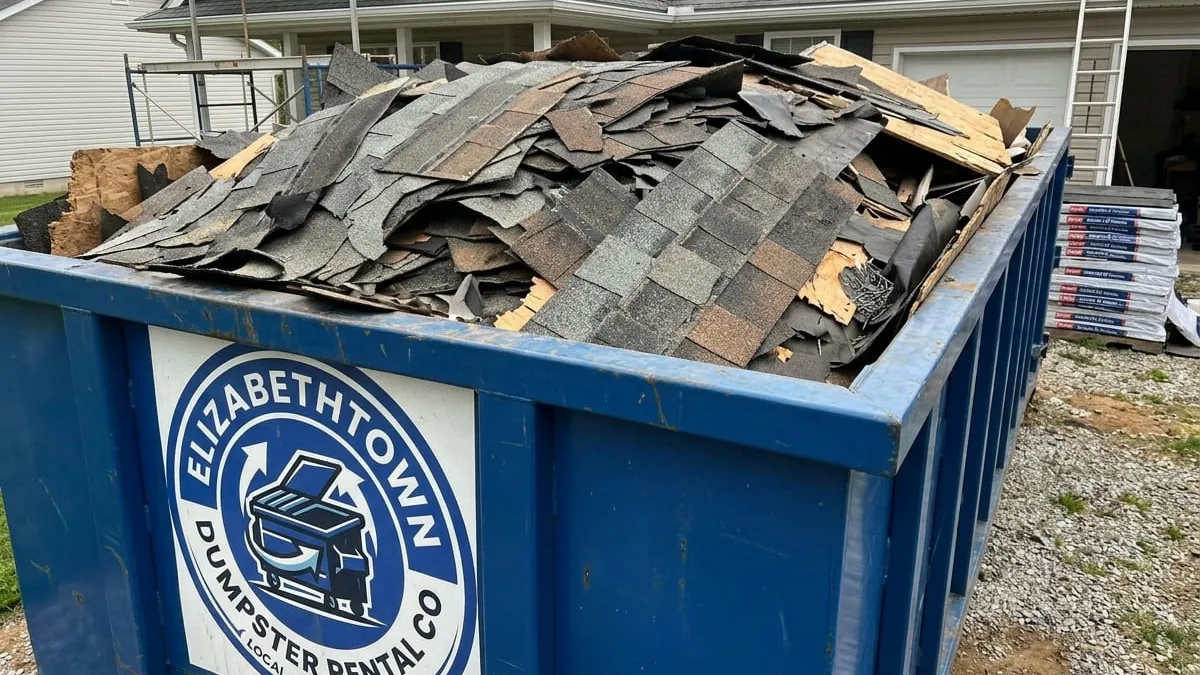
The single most useful thing anybody can tell you about a roofing container is that you are not filling it, you are loading it to a weight. Torn asphalt shingle is dense, it does not compress, and it reaches a lawful road payload long before it reaches the top rail of a large box. That is why the ceiling on this page is firm and why we will say no to it if you ask: roofing never goes in a 30 or a 40. A 30 yard container a third full of shingle is a truck that cannot lawfully leave your driveway, and the person who pays for that discovery is you, in a wasted morning. A single-layer tear-off on an ordinary Hardin County house goes in a 15 yard. A large roof, a two-layer tear-off, or a job where the decking comes off with the shingle goes in a 20 yard. Anything beyond that is a second pull booked in advance, not a bigger container.
The second thing is what to count. Not the footprint of the house, and not the number of bedrooms: squares of roof surface, and layers. A square is a hundred square feet of finished roof. Pitch adds surface that the footprint does not show, dormers and valleys add both surface and waste, and a second layer roughly doubles the tonnage while adding nothing to the plan view. On Hardin County houses that is not an edge case. About two in five homes in the county were built before 1980, and the single biggest decade is the 1970s at 16.2 percent — houses now on their second or third roof, in an era when roofing over an existing layer was normal practice. If you do not know how many layers are up there, say so when you book and we will size for the pessimistic answer, which is cheaper than being wrong the other way.
The third thing is water, and in this county it is not a footnote. Hardin County gets around fifty inches of rain a year and there is no dry season in it. May is the wettest month on the calendar and it is also peak roofing season. Shingle absorbs, felt absorbs, and torn decking absorbs a great deal; a container left open across a wet weekend gains weight that you will pay to haul and that does nothing for you. Keep a tarp on it overnight, or at minimum plan the last course so it sheds. If you have a choice of month for a discretionary re-roof, September is the driest month here and still mild, which makes it the best window of the year for outdoor work in this market.
The fourth thing is age, and it changes the sequence rather than the size. The federal lead rule draws its line at housing built before 1978, and a large share of Hardin County’s pre-1980 stock sits on the older side of that line. Where paid work will disturb painted surfaces on a pre-1978 house — and roof work often reaches fascia, soffit, trim and siding — the firm doing it needs to be certified in lead-safe work practices. The Kentucky-specific point that most sites get wrong: Kentucky is not one of the states EPA has authorized to run that program, so certification comes from EPA directly. Lead abatement is the piece Kentucky does run itself, through its own Environmental Lead Program. The National Lead Information Center is 1-800-424-5323. That is an obligation on whoever is doing the work, not on us — but it is a scheduling fact, so raise it early.
And the fifth is the state fire code, because roofing is the one residential job where somebody always brings it up. Kentucky’s fire code is the Kentucky Standards of Safety, 815 KAR 10:060, adopting NFPA 1 (2018), whose combustible waste and refuse provisions are in Chapter 19 — and Section 2(1) of that regulation says it applies to all buildings except one and two family dwellings. A container on the driveway at a single-family house in Elizabethtown is not what the state fire code is written about. On anything other than a one- or two-family dwelling — a triplex, a fourplex, an apartment block, a store, a school or any commercial building, it is — and inside the city limits the desk that looks at it is Elizabethtown Fire Prevention, (270) 765-2121. Ring the yard on (270) 900-6891 with your squares and your layers.
Tear-Offs This County Buys Containers For
Single-Layer Asphalt Tear-Off
The commonest roofing job in this market and the reason the 15 yard exists. One layer off an ordinary ranch or split-level, loaded flat and level, with the box backed as close to the eave or the gable end as the ground allows so the shovel run is short.
Two-Layer Tear-Off On A 1970s House
Roofing over was standard practice for years, and it is common on this county’s biggest housing decade. A second layer roughly doubles the tonnage without changing the plan view at all, which is why this job steps up to a 20 yard rather than staying in a 15.
Tear-Off With Decking Replacement
Once the sheathing is coming off with the shingle, the load changes character: heavier, bulkier and full of fixings. Plan for a 20 and keep the nails contained, because a decking job spreads more debris across a yard than any other roofing work.
Storm And Wind Damage Repair
Partial tear-offs, blown ridge, lifted shingle, damaged flashing and the litter across the yard. Mixed and awkward rather than uniformly heavy, and it usually arrives on short notice — our same-day page covers how quickly a box can be there.
Metal Roof Removal
Panels, purlins, fixings and old felt. Bulky rather than dense, and it wants a container with the sides to hold long panels without them projecting above the rail. Keep it separate from asphalt if you can — clean metal has routes that a mixed load loses.
Shed, Garage And Outbuilding Roofs
Small enough that people are tempted to use a household route for it. The City’s spring clean-up refuses “construction debris” in writing, and brush collection excludes contractor work outright, so even a small roof needs its own plan.
Commercial Flat Roof Replacement
Membrane, insulation board, ballast and old built-up material. Ballast is where a flat roof gets dangerous for sizing: gravel is a weight load hiding in a volume job, so it comes out separately. And on a commercial building the state fire code is in scope for the container.
Gutter, Fascia And Soffit Replacement Packages
Usually bolted onto a re-roof, and usually where the lead question lives, because that is the painted trim on a pre-1978 house. Light, awkward material that loads fast. Bag the small stuff so it does not blow — § 92.031(B) is written about exactly that.
Squares, Layers And Why The Ceiling Is Firm
Roofing is the one service on this site where bigger is wrong, and the sizing is decided by weight rather than by volume. An ordinary single-layer asphalt tear-off on a Hardin County house belongs in a 15 yard. A large roof, a two-layer tear-off, or a job where the decking is coming off with the shingle belongs in a 20 yard. Past that, the answer is a 20 plus a second pull booked before the crew starts, rather than a taller box — because torn shingle reaches a lawful road payload while a large container still looks like it has room in it. Roofing never goes in a 30 or a 40. Where a re-roof is bundled with siding or windows, run two containers: the shingle in a small one loaded flat, the packaging and trim in something taller. And if a flat roof has ballast on it, that gravel is its own load and belongs in a 10. Our tear-off sizing guide works through the arithmetic square by square.
10 Yard Dumpster
Broken driveway, block and footing spoil. Limestone is dense: this one is full by weight long before it looks it.
View this size →15yd³15 Yard Dumpster
A single-layer tear-off, or one room of a 1970s Hardin County house stripped to the studs.
View this size →20yd³20 Yard Dumpster
What leaves the North Dixie yard most weeks — an attic, a garage and a basement in one go.
View this size →Placement At The Eave, And Rain On An Open Box
A roofing container earns its keep by being close, and being close is where the damage happens. Surface first. Plywood under the wheels and the rear rollers every time, and concrete or compacted base rather than turf — because the box will be loaded heavier per cubic yard on this job than on any other, and in a county with rain in every month the ground is rarely at its best. Position second. The right place is square to the eave or the gable you are working off, close enough that the shovel run is short and clear enough that the tarp can come over it at the end of the day. Watch the drip line, the gutter you are about to remove, and anything at ground level in the fall zone: air conditioning condensers, gas meters, downspout boots and landscape lighting all live exactly where the shingle wants to land. Overhead third. The hoist needs real clearance, and on older Hardin County properties the two obstacles are a mature shade tree over the only flat spot and a service drop crossing the drive. Tell us at booking rather than on the morning. Water fourth, and this is the local one. There is no dry season here and May is the wettest month of the year, which is squarely inside roofing season. Torn shingle, felt and old decking all absorb, and an open box across a wet weekend is heavier on Monday for no benefit to anybody. Tarp it. Fifth, the fire code, stated properly. Kentucky’s state fire code is NFPA 1 (2018) via 815 KAR 10:060, its combustible waste and refuse provisions are in Chapter 19, and Section 2(1) exempts one and two family dwellings from the regulation altogether. So at a house, that code is not the constraint; at anything other than a one- or two-family dwelling — a triplex, a fourplex, an apartment block, a store, a school or any commercial building it is, and inside the city limits Elizabethtown Fire Prevention on (270) 765-2121 is who assesses it. Sixth, the nails. A magnet sweep of the drive, the lawn and the street is not optional in a market where the same driveway will take a loaded truck the following morning. Our driveway protection notes cover the rest.
Not sure this is your page? Say what the job actually is and we will point you at the right box — including on the days when that means sending you somewhere else on this site entirely. Ring (270) 900-6891.
One flat number
Give us the street address and say what is going in. You get a size, a figure and a day. Nothing to fill in.
(270) 900-6891Sizes that suit it
How it works
Roofing Dumpster Rental in four steps
- 1
Tell us the job
Two minutes, and a street name and a nearest crossroad is enough. Tell us the address rather than the mailing town — on this side of Elizabethtown the two are not always the same thing. You hang up with a flat number that has the disposal inside it.
- 2
We set it down
The driver walks the approach first and puts plywood under both rails and every wheel. Where the box stands tight against a commercial building, the fire officials with jurisdiction at that address are the people who will actually look at it — inside the Elizabethtown city limits, that is Fire Prevention on (270) 765-2121.
- 3
Fill it flat and low
Use the days in your window. Heavy on the bottom, nothing standing proud of the rail, and keep it covered — there is no dry season here, and water is weight.
- 4
Say the word
Ring and we pull it. Metal and cardboard come out on the way, and the rest goes to a permitted Kentucky disposal facility.
Roofing Dumpster Rental FAQs
Why can I not put a roof in a 30 yard?
Because you would never fill it, and you would break the truck’s payload trying. Torn asphalt shingle is dense and does not compress: a square of it weighs far more than a square of almost anything else that comes off a house, and a 30 yard container loaded with shingle hits a lawful road payload when it is roughly a third full. At that point the box cannot lawfully leave your driveway, and the only remedies are unloading it by hand or splitting the load — both of which cost you a morning. The correct answer for a roof bigger than a 20 is a 20 plus a second pull booked before the crew starts, arranged at booking rather than discovered at noon on tear-off day. It is the same total tonnage, moved legally. Tell us your squares and layers on (270) 900-6891.
How do I work out squares and layers?
A square is one hundred square feet of finished roof surface. Measure the roof, not the footprint of the house — pitch adds area that a plan view hides, and dormers, valleys and hips add both area and waste. Then count layers, because a second layer roughly doubles the debris while changing the measurement not at all. On Hardin County housing that is a live question rather than a technicality: about 38.6 percent of the county’s homes were built before 1980, the 1970s is the single biggest decade at 16.2 percent, and roofing over an existing layer was standard practice through much of that period. Lift a shingle at a rake edge or look at the depth at a rooftop vent flashing. If you genuinely cannot tell, say so and we will size for two layers — the cost of being wrong that way is small, and the cost of being wrong the other way is a stopped job.
Does the state fire code say how far the container must sit from the house?
Not at a house, and that is a genuinely Kentucky answer. The Commonwealth’s fire code is the Kentucky Standards of Safety, 815 KAR 10:060, which adopts NFPA 1, Uniform Fire Code, 2018 edition; its combustible waste and refuse provisions sit in Chapter 19. But Section 2(1) of that regulation states it applies to “all buildings except one (1) and two (2) family dwellings.” A single-family house or a duplex is outside its scope, so a driveway container at one is not what that code governs. A triplex or a fourplex, on the other hand, is inside scope — the exemption stops at two — as is any store, school, warehouse or commercial building. Inside the Elizabethtown city limits the people who will look at your placement there are Elizabethtown Fire Prevention, (270) 765-2121. If a competitor quotes you a clearance from the International Fire Code for a Kentucky job, they are citing a code the Commonwealth does not adopt.
Can I put the old decking and the gutters in with the shingle?
Decking, yes — it belongs in the same load and it is one of the reasons a decking job steps up from a 15 to a 20. Gutters, fascia and soffit are fine as content too, but they are bulky and light against shingle that is dense and heavy, so the box fills unevenly and the weight arrives before the volume does. If the job is a full package — roof plus siding plus windows — two containers is nearly always the better arrangement: shingle in a small box loaded flat, everything else in something taller. One thing to keep out: tires, if the old ones are stacked behind the garage and it feels like a good moment. Under KRS 224.50-856 waste tires only go to a permitted facility, and the City’s own spring clean-up refuses them too.
When is the best time of year to re-roof in Hardin County?
If the roof is failing, now. If it is discretionary, September. Hardin County gets around fifty inches of rain a year and there is no dry season in it — but May is the wettest month at nearly six inches, and September is the driest at a little over three, while still being mild enough for comfortable outdoor work. That combination makes September the best working month of the year here, and it is also outside the summer stretch when the Army’s permanent change of station season runs June through August and local trade demand is at its highest. Winter is workable between systems, but the risk in this county is ice rather than snow depth, and an ice event will stop a roof crew and a truck on the same morning. Book the container the day before tear-off, not the morning of.
More services
Other things we haul
Residential Dumpster Rental
Two in five Hardin County houses predate 1980, and their attics and garages show it.
Learn more →Commercial Dumpster Rental
Businesses inside the limits, where Fire Prevention on (270) 765-2121 will look at the box.
Learn more →Construction Dumpster Rental
Mixed build waste in one box, swapped next day, from the city line out to the county roads.
Learn more →Roll-Off Dumpster Rental
Five box sizes, out of the North Dixie Highway yard every working day of the week.
Learn more →Same-Day Dumpster Rental
Call before nine and the afternoon board usually still has a slot on it.
Learn more →Junk Removal Dumpsters
Clear a house, an outbuilding or a rental unit at whatever pace the week allows.
Learn more →Estate Cleanout Dumpsters
Patient work for a family emptying a house that one person kept for fifty years.
Learn more →Demolition Debris Removal
Porches, outbuildings and strip-outs — and in the city a demolition permit comes first.
Learn more →Concrete & Heavy Debris
Its own box for slab, block and limestone, loaded flat in a single layer across the floor.
Learn more →Yard Waste & Brush Removal
Its own clean load — the City’s brush round refuses anything from clearing land.
Learn more →Where we deliver
Roofing Dumpster Rental across Hardin County and the Lincoln Trail region
Same crew and the same flat rate across all seventeen. Open your own page for the placement notes and for which of the four desks governs the job.
Talk to a real person
Need roofing dumpster rental in Elizabethtown?
Give us the street address rather than the mailing town, say what is going in, and you will have the size, one flat figure and a day before you hang up. Nothing on this site to fill in, and nothing waiting in an inbox overnight.
Elizabethtown, the rest of Hardin County, and seventeen more places across seven counties · Mon–Fri 6:30am–5pm, Sat 7am–1pm