
Sizing Guide
Roof Tear-Off Dumpster Sizing in Elizabethtown
Two in five Hardin County homes predate 1980 and the biggest single decade is the 1970s, which is the decade that layers. Count the layers before you order, because weight decides the size.
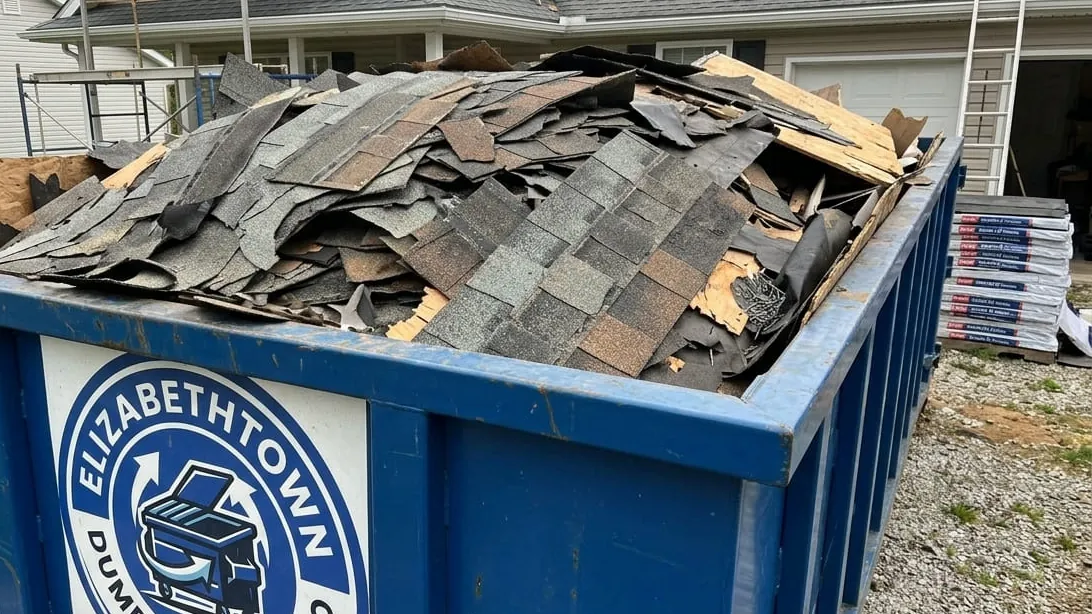
There is one sentence that decides every roofing container in Hardin County, and it is worth putting before anything else:
Roofing fills a container by weight long before it fills it by volume.
Everything on this page follows from that. Asphalt shingle is dense. Layered, nailed, gritted with decades of granule and often still wet from the weather that caused the job, it is one of the heaviest materials that goes into a box on a residential street. A tear-off reaches its lawful payload with the container nowhere near full.
Which produces the second sentence, the one people argue with until they have watched it happen:
A roof tear-off never goes in a 30-yard or a 40-yard container.
Not because we do not have them. Not because the shingle would not physically fit. Because a 30 or a 40 loaded with tear-off is a truck that cannot lawfully leave your driveway. All that extra capacity is capacity nobody is ever allowed to use, and the only thing a big box reliably produces on a roofing job is a half-full container that nobody can move and a homeowner who is annoyed about both.
What size you actually want
- A 15-yard container is the working answer for an ordinary single-layer tear-off on an ordinary house. One covering, a straightforward roof, and the 15 is right.
- A 20-yard container is the answer for a large roof, for two layers, or where decking is coming off with the shingle. Board or plywood decking adds real bulk on top of the weight.
- Beyond that, the answer is a second pull, not a bigger box. We take the full one, bring an empty one, and the crew keeps working. Two right-sized containers is not a planning failure on a big roof. It is the plan.
If you are unsure which side of that line you are on, tell us three things: the rough footprint of the house, whether the roof is a simple gable or cut up with dormers, valleys and a couple of additions, and — the one that matters most in this county — how many layers are up there.
Why Hardin County roofs run to layers
Here is where the local numbers change the answer, and they change it in a direction that a crew from a newer market will get wrong.
About two in five homes in Hardin County were built before 1980 — roughly 38.6% of the housing stock, per the American Community Survey’s 2019–2023 estimates, which works out to somewhere around 18,500 units. And the shape of that distribution matters as much as the total: the single biggest decade in the county is the 1970s, at 16.2%, close to 7,800 homes. The biggest decade overall is the 2000s at 18.2%, which is a different story for a different page.
A house built in 1974 has had fifty years of roofing decisions made about it, usually by a succession of owners, usually one at a time and usually under pressure. Somewhere in that history it is common for at least one crew to have gone over the top rather than tearing off — that was ordinary practice for a long stretch of that period. Which is why a meaningful share of roofs in Rineyville, Cecilia, Vine Grove and the older streets of Elizabethtown are on their second or third covering.
Two layers is not twice the nuisance. It is twice the weight in the same volume — which is precisely the axis that constrains a roofing container. Somebody who has been sizing boxes in a subdivision built after 2000, where nearly every roof is on its first covering, will under-size a job in a 1970s neighborhood every time.
Count the layers before you order the container. Any roofer can tell you from the eave in about thirty seconds, and it changes the answer.
What else ends up in the box
A tear-off is almost never only shingle. Leave room for:
- Felt and underlayment, which comes off in heavy, awkward sheets and takes more space than anyone expects
- Flashing, drip edge, vents, pipe boots and ridge vent — light, but bulky
- Rotten decking, which you will not know about until the covering is off. On a fifty-year-old roof in a county that gets around fifty inches of rain a year, budget for some.
- An old wood shake layer hiding under everything else on the oldest houses
- Gutters and downspouts, if they are going at the same time, which they often are
Kentucky’s own regulations put all of that in one clearly defined bucket. The Commonwealth defines construction and demolition debris as “waste resulting from the construction, remodeling, repair, and demolition of structures and roads, and for the disposal of uncontaminated solid waste consisting of vegetation resulting from land clearing and grubbing, utility line maintenance, and seasonal and storm related cleanup.” A tear-off is squarely inside that. Note the word uncontaminated, though, because it does real work — see the next section.
That definition matters more here than in most states, because Kentucky permits disposal facilities in classes: contained landfills, construction and demolition debris landfills, inert landfills, residual and special waste. So “where does it go” genuinely has a different answer for a roof tear-off than for a kitchen remodel. Hardin County runs its own permitted contained landfill on Audubon Trace in Elizabethtown, operated by the Fiscal Court; questions about it go to the County on (270) 360-9207, not to us. Everything else that leaves a job here goes to a permitted Kentucky disposal facility, and which class it goes to depends on what is in the load.
What does not go in, and why the reason here is local
Three categories stay out of a roofing container.
Liquids of any kind — roofing cement, solvent, sealant, thinner, the half can of driveway sealer that was in the garage. In most of America, tipping something like that on the ground is a slow problem. In Hardin County it is a fast one. The Kentucky Energy and Environment Cabinet describes karst terrain as characterized by “the rapid movement of water through underground channels and conduits,” which “renders karst terranes sensitive to groundwater pollution,” and the Kentucky Geological Survey puts it more bluntly still: pollutants entering a karst aquifer are “not filtered.” Elizabethtown is one of the karst cities KGS names in the Western Pennyroyal region. That is the real reason the City’s own spring clean-up refuses “hazardous materials, liquids (paints, oil, antifreeze, etc.),” and it is why Hardin County runs an annual household hazardous waste event rather than taking that material at a drop-off. More in the karst guide.
Solvent-soaked and oily rags. Spontaneous ignition in a pile of rags is a well-documented cause of job-site fires. Keep them out of the box and out of the pile next to it, and deal with them properly.
Tires. If the old set behind the garage is going at the same time, it goes on its own. KRS 224.50-856 allows waste tire disposal only “by transfer to a permitted solid waste disposal facility,” with a threshold of fifty above which the Commonwealth’s transporter rules apply. That is the single Kentucky-specific disposal restriction this company will assert. For anything else you may have read about Kentucky landfill bans, we looked and could not verify it.
The fire question, answered correctly for Kentucky
Most roofing pages you will read tell you to keep the container a set number of feet from the wall and cite the International Fire Code. Kentucky does not use the International Fire Code. The Commonwealth’s fire code is the Kentucky Standards of Safety, 815 KAR 10:060, which adopts NFPA 1, Uniform Fire Code, 2018 edition, and NFPA 1’s container and refuse rules sit in Chapter 19, “Combustible Waste and Refuse.”
And then the part almost nobody carries with it. Section 2(1) of that regulation says: “This administrative regulation shall apply to all buildings except one (1) and two (2) family dwellings.” On a single-family house or a duplex, the state fire code does not reach your driveway at all. On an apartment building, a church, a store or a warehouse, it does — and the people who will actually look at it are Elizabethtown Fire Prevention, (270) 765-2121.
We are not publishing a clearance distance in feet for Kentucky, because we could not verify one from a source we trust. That is the full and honest answer, and the Kentucky code guide explains exactly why.
Weather, weight and the calendar
This county gets roughly fifty inches of rain a year, and it is spread across every month. There is no dry season in Hardin County. That has one direct consequence for a roofing container: an open box will catch water, and water is weight — the exact commodity you are already short of on a tear-off. Tarp it at the end of every day the crew is not loading, and tarp it before you leave it over a weekend.
Two more dates worth knowing:
- May is the wettest month of the year here — a little under six inches on the long-run normals — and it is also peak renovation season. That is an unhelpful combination and it is worth planning around.
- September is the driest month, a little over three inches, and still mild. If you have any freedom in the schedule, September is the best month in the year in this county for an outdoor tear-off.
And winter here is an ice problem, not a snow problem. Hardin County averages only about five inches of snow a year, but December through February lows average in the low-to-mid twenties, and the region’s signature winter hazard is freezing rain. Ice changes a roofing job in three ways: the roof itself, obviously; a tarp frozen to a load, which is a genuine nuisance; and a driveway a loaded truck has to back down. If the forecast has freezing rain in it, move the delivery, not the crew.
Where the container goes on a roofing job
Roofing containers sit for days, get loaded from height, and take punishment. Placement matters more here than on almost any other job.
- The driveway is usually right — close to the work, hard surface, off the street entirely. Put plywood under the wheels and boards under the rails. On the older half of this housing stock those drives are decades old, and a concentrated tear-off load is worth planning for. The driveway protection guide goes through it properly, including the part about what is underneath a driveway in this county.
- Not on the lawn after rain, and around here it has usually rained. Ruts in wet ground are the single most common avoidable complaint in this business.
- Watch the overhead. The truck has to raise the box to set it and again to take it. The service drop to the house and a mature tree over the drive are the two things that stop a delivery in an older Elizabethtown neighborhood.
- Think about the throw. Shingle coming off a roof travels. Move vehicles, cover the AC condenser, and think about which side of the box the crew will actually be standing on.
- In the street is a different question. Call the City on (270) 765-6121 and Public Works on (270) 737-7890 first, and do not assume driveway rules apply in a public street. If the property fronts US 31W, US 62, US 31E or another state route, the right-of-way is a Kentucky Transportation Cabinet matter and the desk is KYTC District 4, (270) 766-5146.
The City will not take it, and it says so in writing
This is worth knowing before somebody suggests putting the old shingle at the curb.
The City of Elizabethtown’s Spring Clean-Up — published for 2026 as March 30 through May 1 for junk and debris — refuses, in the City’s own words, “No garbage, hazardous materials, liquids (paints, oil, antifreeze, etc.), construction debris, tires, or automobiles.” Five weeks a year the City will take almost anything, and the one thing it will not take is exactly what a roof produces. Those dates move every year; confirm with Public Works, (270) 737-7890.
The City’s brush collection program does not help either. It takes only “debris resulting from trees and shrubs which have been pruned or trimmed,” under twelve inches in diameter and five feet in length, on a four-week rotating schedule across four areas that took effect on 1 October 2024. And it says the quiet part out loud: “Licensed contractors must remove and dispose of debris from their own work professionally.”
And inside the city limits, burning is not the escape hatch. Under § 92.031(I) it is a nuisance to burn garbage anywhere in the city, and a nuisance to burn debris or rubbish except in an approved incinerator. Only wood, tree branches and yard trimmings may be burned at all, and only with Fire Chief approval, a permit if required, at least fifty feet from any structure, monitored by an adult with an extinguishing agent at hand. Shingle is not on that list.
The half of the job that happens after the container leaves
Nails. A tear-off scatters thousands of them across the lawn, the drive, the flower beds and the gravel. A rolling magnet over every surface, more than once, in more than one direction, is the only method that works, and it should be done before the container goes, not after.
Granules. Shingle grit ends up in gutter runs, window wells and landscaping stone, and it does not wash away. Budget an hour.
The pile that is left. A stack of old shingle beside the drive three weeks after the roofers finished is not merely untidy here. Elizabethtown’s code treats accumulation itself as the offense: weekly disposal is required under § 92.031(F), loose material that wind can move has to be covered under § 92.031(B), and § 92.030 makes a violation of that subchapter a public nuisance. Load it, or have it loaded, before the crew leaves the street.
The short version
- 15 for an ordinary single-layer house tear-off.
- 20 for a large roof, two layers, or decking coming off.
- Never a 30 or a 40. Past a 20, the answer is a second pull.
- Count the layers first. The 1970s is the biggest decade in this county’s housing stock, and that is the decade that layers.
- Tarp it. Fifty inches of rain a year, no dry season, and water is weight.
- Ice, not snow, is the winter problem. Move the delivery, not the crew.
- No liquids, no oily rags, no tires.
- Single-family house or duplex: the state fire code does not reach it. Commercial: NFPA 1 Chapter 19, and Fire Prevention on (270) 765-2121.
Call (270) 900-6891 with the address, the rough roof size and the number of layers, and we will tell you the container and how many pulls it will take. More on roofing containers, on the 15 and the 20, and in the general sizing guide. The forecast office for Hardin County is NWS Louisville.
Questions this guide did not answer? Call (270) 900-6891. We would rather spend two minutes on the phone than have you order the wrong container.